If your heat pump is icing up in winter, don't assume something has failed.
A light coating of frost on an outdoor heat pump can be completely normal during cold, damp Ontario weather. Air-source heat pumps are designed to deal with frost through an automatic defrost cycle.
A heat pump covered in heavy ice is different.
If ice continues building, covers much of the outdoor coil, blocks airflow, returns immediately after defrost, or your home is no longer heating properly, the system may have an airflow, drainage, refrigerant, fan, sensor, control, or defrost problem.
Light frost that disappears = usually normal. Heavy ice that stays or keeps returning = get it checked.
For homeowners in Peterborough, Lindsay, Kawartha Lakes and surrounding areas, winter weather creates demanding conditions for outdoor HVAC equipment. Snow accumulation, freezing rain, moisture, rapid temperature swings and extended periods below freezing can all affect what you see on your heat pump.
The Gravity Group provides heat pump repair, maintenance, replacement and installation throughout Peterborough, Lindsay, Kawartha Lakes and surrounding communities.
Heat pump frozen or not heating properly?
Call The Gravity Group at 705-344-6835. We answer 24/7.
Quick Answer: Is Ice on a Heat Pump Normal in Winter?
Some frost on a heat pump is normal during winter. A heat pump completely covered in ice is not.
When an air-source heat pump heats your home, its outdoor coil becomes cold. Moisture in the outdoor air can condense on the coil and freeze.
The heat pump should periodically enter a defrost cycle to melt this frost.
Natural Resources Canada explains that air-source heat pumps use a defrost cycle specifically because moisture can freeze on the outdoor coil during heating operation. Frost reduces the coil's ability to transfer heat, so the system temporarily changes operation to remove it.
You should be more concerned when:
- Ice becomes thick or solid
- The entire outdoor coil is encased in ice
- Ice remains after a defrost cycle
- The unit repeatedly freezes again
- The outdoor fan cannot turn properly
- Ice blocks airflow through the coil
- Your home is getting colder
- The heat pump runs constantly without reaching temperature
- The system repeatedly switches to auxiliary or backup heat
- You hear unusual noises from the outdoor unit
- A breaker repeatedly trips
- Water continually drips onto the heat pump and freezes
Those symptoms point toward something beyond normal winter frost.
Why Does a Heat Pump Develop Frost in Winter?
To understand why a heat pump gets frosty, it helps to understand what the equipment is actually doing.
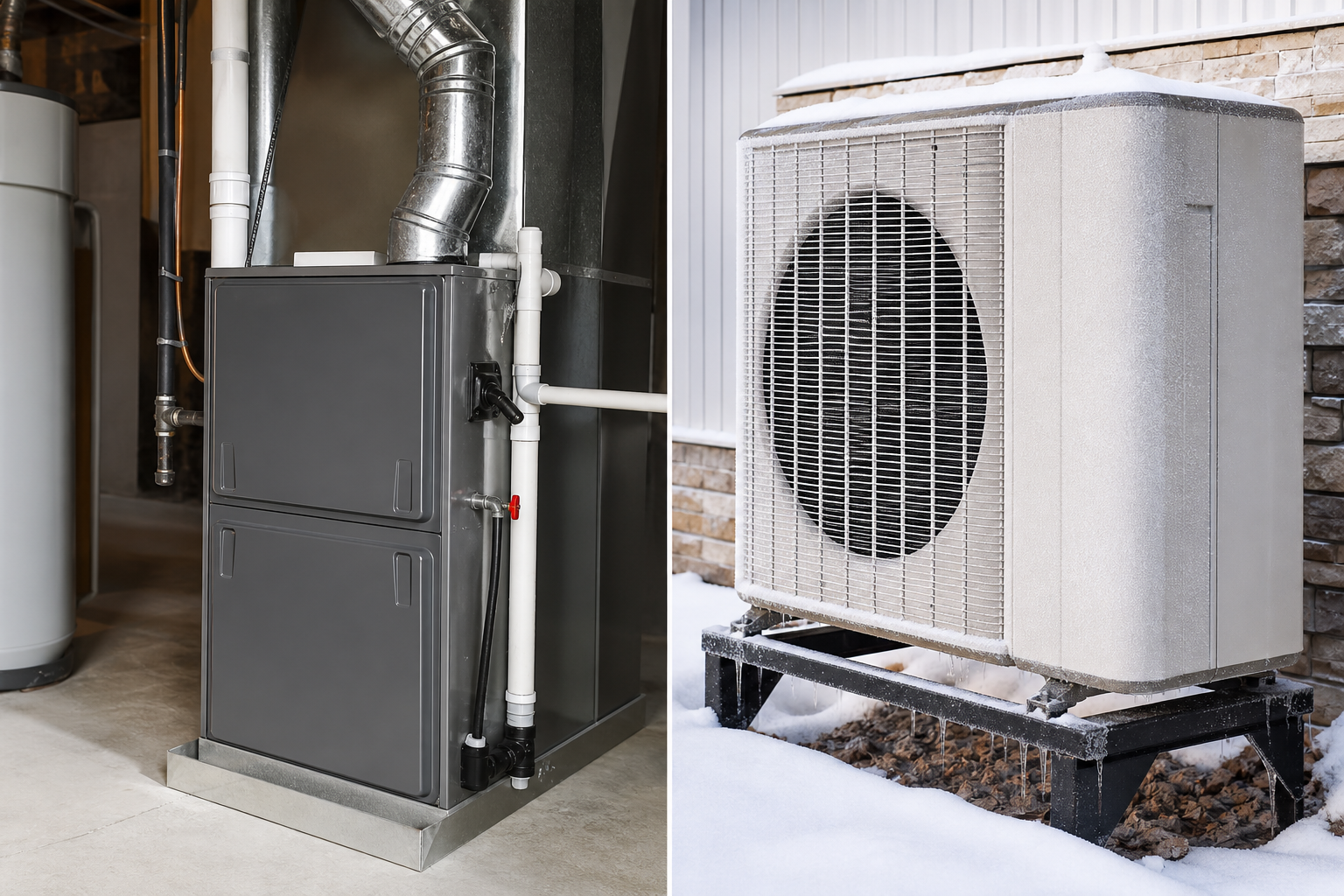
A furnace creates heat. An air-source heat pump primarily moves heat.
During winter, the system extracts heat from the outdoor air and transfers that heat into your home. Yes — outdoor air still contains usable thermal energy when temperatures drop below 0°C.
Modern cold-climate heat pumps can operate at temperatures far below freezing. Natural Resources Canada states that cold-climate air-source heat pumps are designed for Canadian conditions and some models can operate at temperatures around -30°C.
While the heat pump is extracting energy from outdoor air, the outdoor coil becomes colder than the surrounding air. When moist air moves across that cold coil, moisture can condense. When the coil temperature is below freezing, that moisture becomes frost.
So seeing some frost does not mean your heat pump has failed. The system was designed with this in mind. For more on heat pump vs furnace choices, see gas furnace or heat pump: which is best.
What Does Normal Heat Pump Frost Look Like?
Normal winter frost is usually:
- Light
- Relatively even across the outdoor coil
- Temporary
- Cleared during defrost
- Not preventing the fan from operating
- Not completely encasing the unit
- Not stopping the house from heating
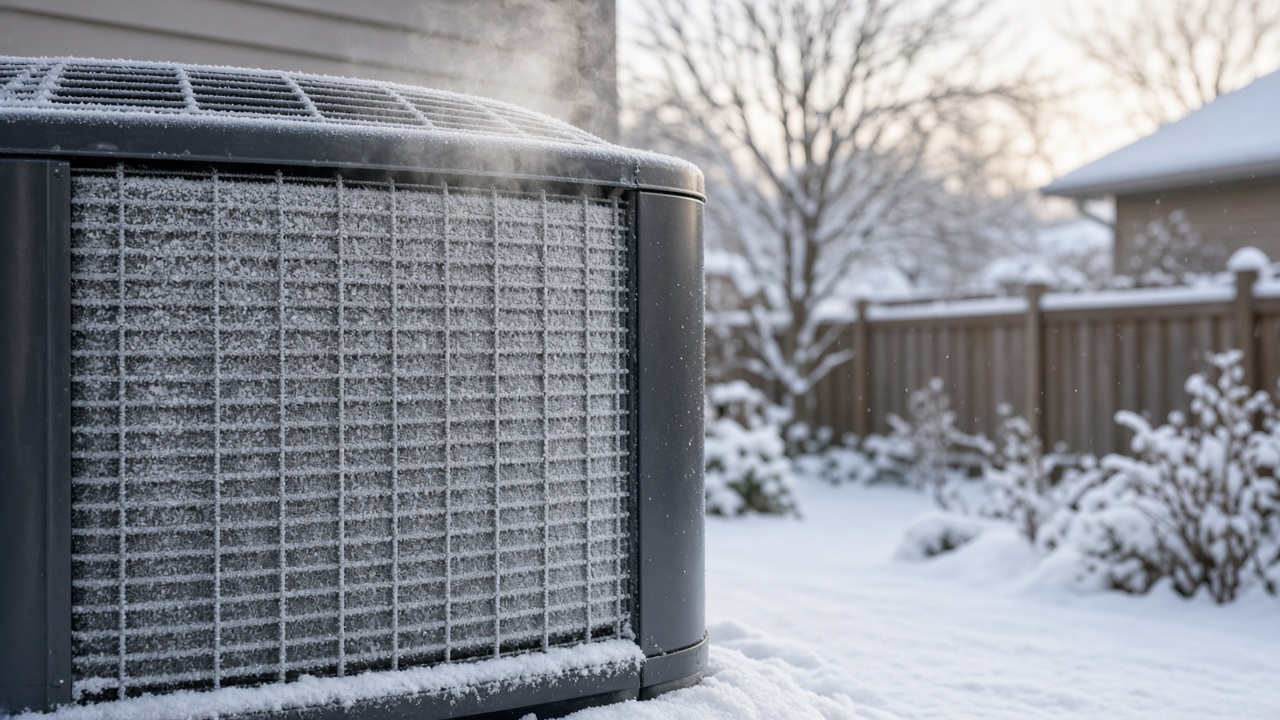
You might check your outdoor unit one morning and see a thin white coating across the coil. Later, you look again and it is gone. That is generally what you want to see.
The heat pump detected conditions requiring defrost, ran its defrost cycle, removed the frost, and returned to normal heating.
Carrier similarly notes that a light frost layer during winter can be normal, while thick or persistent ice that fails to clear during defrost calls for attention.
What Does Abnormal Heat Pump Ice Look Like?
The problem becomes more obvious when frost turns into substantial ice.
Warning signs include:
Thick ice around the outdoor coil
If you cannot clearly see the coil because it is hidden behind ice, the system may not be defrosting correctly.
Ice covering large sections of the cabinet
Ice extending far beyond a light coating on the coil can point to drainage, weather, defrost or mechanical problems.
Large icicles hanging from the unit
A few frozen drips after defrost may occur in certain conditions. Large or continually growing icicles deserve attention, particularly if water is falling onto the unit from somewhere else.
Ice around the fan
If ice interferes with the outdoor fan, stop treating the situation as normal frost.
Ice that never disappears
A functioning heat pump should be able to clear ordinary frost through its defrost cycle. Persistent ice suggests the system needs inspection.
Ice that returns rapidly after defrost
The heat pump may successfully remove some ice but freeze again shortly afterward because the underlying problem remains.
Heavy ice that won't clear?
Call Gravity at 705-344-6835 for heat pump diagnosis in Peterborough, Lindsay and Kawartha Lakes.
What Is a Heat Pump Defrost Cycle?
A heat pump's defrost cycle is an automatic process used to remove frost from the outdoor coil.
During normal winter heating operation, the outdoor coil absorbs heat. When enough frost forms, the heat pump detects that defrost is needed.
The system temporarily reverses part of its refrigeration process so warm refrigerant flows through the outdoor coil. That heat melts the frost. The outdoor fan will commonly stop during this process.
Once defrost is complete, the heat pump switches back into normal heating mode.
Natural Resources Canada describes this as a normal operating cycle for air-source heat pumps. Systems can use temperature, pressure, airflow, sensors, time intervals or combinations of these controls to determine when defrost should occur.
Why Is Steam Coming From My Heat Pump?
This one scares homeowners all the time.
Your heat pump is running outside. Suddenly you see what looks like smoke pouring from it.
Before assuming the motor is burning up, look closely. During a winter defrost cycle, steam can be completely normal.
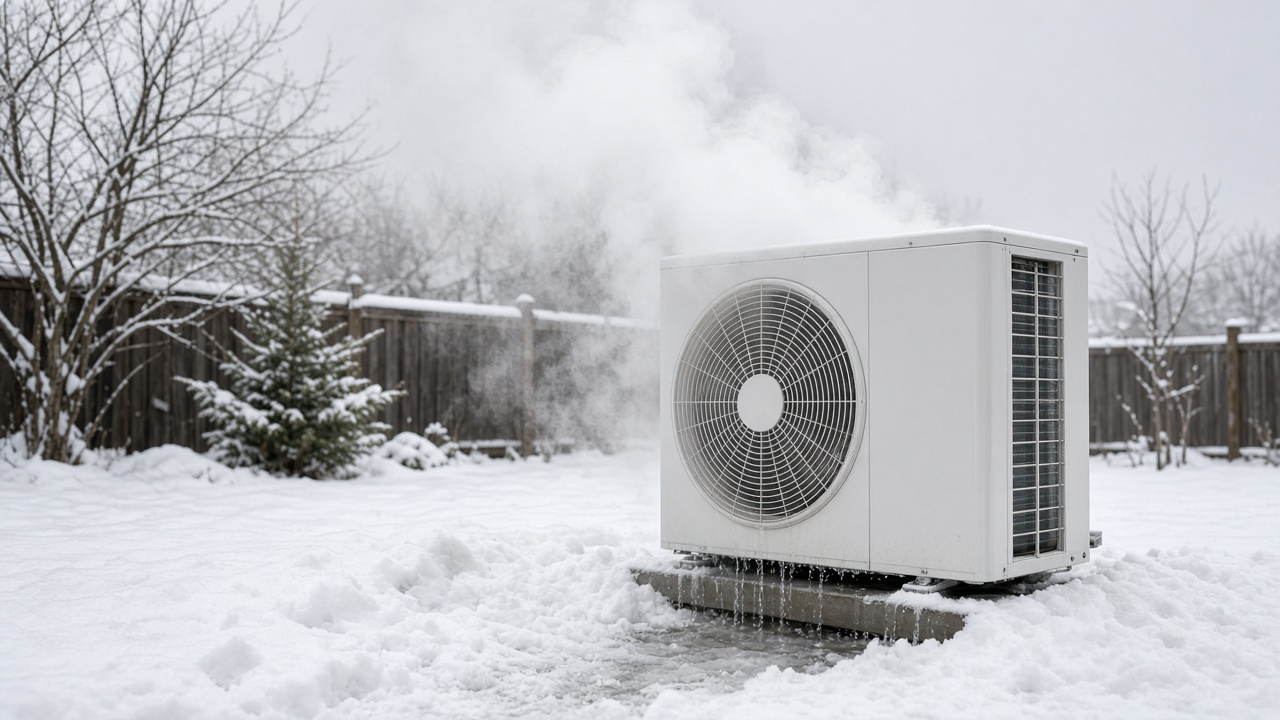
The system is warming the outdoor coil to melt frost. Cold outdoor air meets the warmer moisture created by melting frost. You see a cloud of water vapour.
Trane specifically notes that steam rising from a heat pump during defrost is a normal part of the process.
- Appears during defrost
- Dissipates quickly
- Does not smell burned
- Stops after the defrost cycle
Smoke from an electrical or mechanical failure is different. If you smell burning, hear electrical buzzing, see sparks, or believe the unit is actually smoking, shut the equipment down and call for service.
Why Does My Heat Pump Blow Cooler Air During Defrost?
This can also be normal.
During defrost, the heat pump temporarily changes how refrigerant flows so it can warm the outdoor coil. That means the system is briefly doing something closer to air-conditioning operation at the outdoor unit.
Depending on your system, backup heat may activate to offset the cooler air. If you have a dual-fuel heat pump and furnace system, controls may also manage how the furnace and heat pump work together.
A brief change in supply-air temperature during defrost is not automatically a problem.
The concern is when your heat pump:
- Continues blowing cold air
- Never returns to normal heating
- Cannot maintain indoor temperature
- Runs auxiliary heat continuously
- Remains heavily iced
Carrier identifies defrost operation as one reason homeowners may briefly notice cooler air from a heat pump in heating mode. If the system never recovers and the house stays cold, see our guide on what to do when your furnace has no heat for overlapping heating troubleshooting — or call for heat pump service.
8 Reasons Your Heat Pump May Be Freezing Up
1. The Heat Pump Is Going Through Normal Frost and Defrost Cycles
Start with the simplest explanation. Your heat pump might be working exactly as designed.
Cold coil. Moisture. Frost. Defrost. Frost disappears. Heating resumes. Nothing needs to be repaired.
The key is that the system should be able to remove ordinary frost. If you check the outdoor unit multiple times throughout the day and frost appears and disappears, that generally indicates the defrost system is doing its job.
2. Snow Is Blocking the Outdoor Heat Pump
An outdoor heat pump needs airflow. Snow piled against the sides of the unit can restrict the amount of air moving through the coil.
This is particularly relevant in Peterborough and Kawartha Lakes after significant snowfall or drifting.
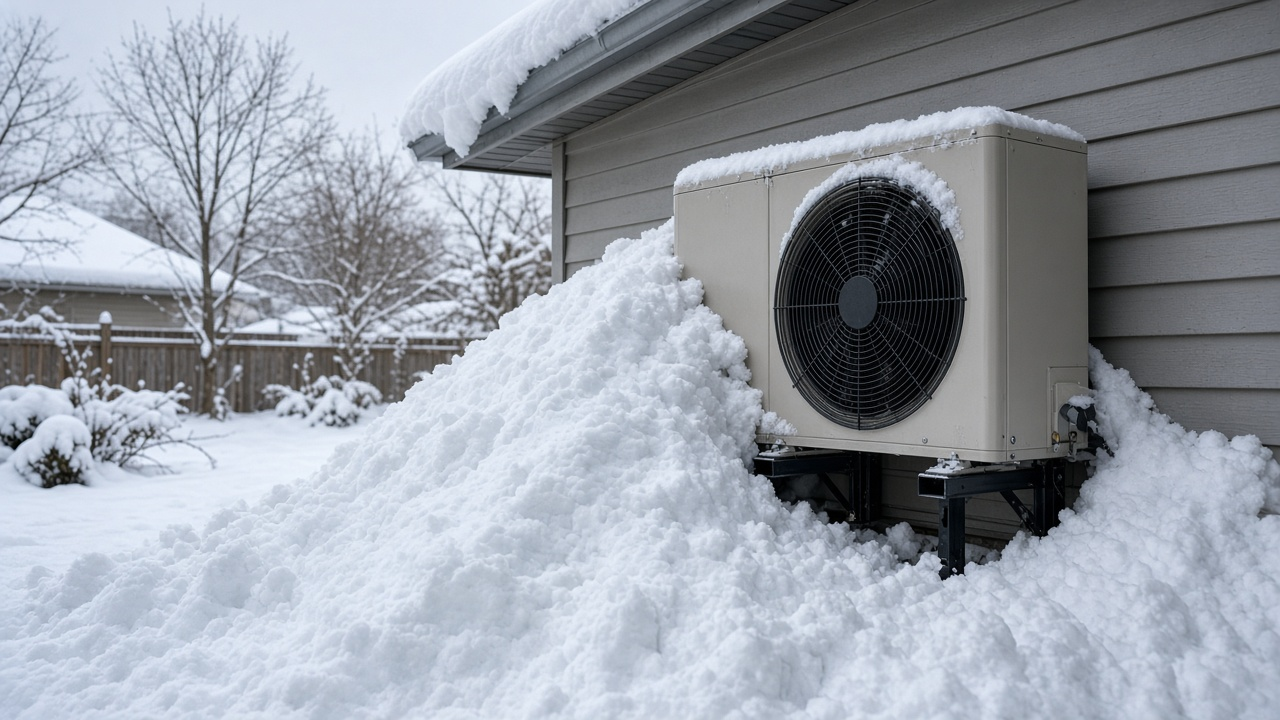
Problems can also happen when:
- A snowblower throws snow against the heat pump
- A plow pushes snow into the unit
- Drifting snow accumulates around one side
- Snow falls from a roof
- The heat pump sits too close to ground level
- Landscaping traps drifting snow around the equipment
Natural Resources Canada recommends checking heat pumps during winter for excessive snow and ice around the outdoor equipment.
What can you do? Keep loose snow from building around the outdoor unit. Do not pack snow against it. Maintain the clearances required by the heat pump manufacturer.
Do not attack the equipment with a shovel. The coil contains thin metal fins and refrigeration tubing that can be damaged relatively easily.
3. The Defrost Cycle Is Not Working Properly
If frost forms normally but never goes away, the defrost system becomes one of the first things an HVAC technician may investigate.
Depending on the heat pump design, the defrost system can involve temperature sensors, coil sensors, pressure sensors, defrost control boards, timers, reversing valves, refrigeration controls and outdoor fan controls.
A failed component can prevent the unit from recognizing frost or completing a successful defrost cycle.
Symptoms may include:
- Outdoor coil completely covered in ice
- Heat pump never appearing to enter defrost
- Defrost starting but stopping incorrectly
- Heat pump freezing repeatedly
- Reduced heating capacity
- Backup heat running frequently
This is not a homeowner repair. An HVAC technician needs to determine which part of the defrost process is failing.
Defrost not clearing the ice?
Book heat pump repair with Gravity. Call 705-344-6835 — live answer 24/7.
4. The Heat Pump May Have Low Refrigerant
Your heat pump relies on refrigerant to move heat. It does not normally "use up" refrigerant like a car burns fuel. The refrigerant operates within a sealed system.
If the refrigerant charge becomes too low, there may be a leak or another system issue. Low refrigerant can affect pressures and coil temperatures and may contribute to freeze-ups and poor heating performance.
Carrier identifies low refrigerant as one potential cause of excessive heat pump icing.
Possible signs include:
- Poor heating performance
- Long run times
- Persistent ice
- Heat pump struggling to reach temperature
- Unusual refrigeration-system sounds
- Higher electricity consumption
- Heavy reliance on backup heat
You cannot accurately diagnose refrigerant charge by looking at the outdoor unit. Refrigerant troubleshooting requires proper HVAC equipment and training. Adding refrigerant without finding the cause of a low charge does not solve the underlying problem.
5. The Outdoor Fan Is Not Working Properly
The large fan on the outdoor heat pump has an important job. It moves outdoor air across the coil so the system can exchange heat.
If the fan stops working correctly, airflow drops. That can contribute to ice accumulation and poor heating performance.
Possible causes include a failed fan motor, electrical problem, control issue, damaged fan blade, ice physically preventing movement, a failed capacitor on applicable systems, or a wiring problem. Carrier lists outdoor fan failure as one possible cause of winter heat pump freeze-ups.
If ice is physically interfering with the fan, don't push the blade manually or chip the ice away with a tool. You can damage fan blades, motor bearings, coil fins, refrigerant tubing and wiring. Call for service.
6. Water Is Dripping Onto the Heat Pump and Freezing
Sometimes the heat pump isn't creating the entire problem. The house is.
Look above and around the outdoor unit. Is water dripping from a leaking eavestrough, a roof edge, melting snow, an overflowing downspout, another mechanical system or a poorly placed drain?
Water can land on the heat pump and freeze. Then more water freezes on top of that ice.
The defrost system was designed to manage frost created during normal heat pump operation. It may not be able to keep up with a continuous stream of water freezing onto the cabinet and coil.
Carrier specifically identifies water runoff onto an outdoor unit as a potential cause of serious icing. Correct the source of the water rather than repeatedly trying to remove the resulting ice.
7. Meltwater Is Not Draining Away Properly
Remember what happens during defrost. Ice melts. That water has to go somewhere.
Outdoor heat pump installations need drainage conditions that allow meltwater to leave the equipment. If water collects beneath or around the heat pump and repeatedly freezes, you can end up with substantial ice around the base.
Problems may include improper equipment elevation, poor site drainage, ice accumulation underneath the unit, drain openings becoming blocked, repeated freeze-thaw cycles and snow trapping meltwater.
This can become particularly noticeable during Ontario winters where daytime thawing is followed by overnight freezing. A properly planned cold-climate installation needs to account for winter drainage, snow depth, equipment clearance and local site conditions.
8. Extreme Winter Weather Is Overwhelming the System
Heat pumps are designed for winter. That does not mean weather never affects them.
Ontario can throw a lot at an outdoor unit: freezing rain, wet snow, ice pellets, blowing snow, high humidity near freezing, rapid freeze-thaw cycles and deep cold.
Cold and humid conditions can be particularly favourable for frost formation.
Cold-climate heat pumps are much more capable than older generations of equipment. Natural Resources Canada reports that modern cold-climate systems can operate at outdoor temperatures approaching -30°C, though actual operating limits depend on the specific model and installation.
Your heat pump should still be matched to your home's heating load and Ontario climate. Equipment selection matters. Installation matters. Controls matter. Backup heating design matters. Looking at Gree and similar options? See our Gree heat pump AC buyer's guide.
Heat Pump Frozen Solid: What Should You Do?
If your heat pump is completely covered in ice, don't start smashing the ice off. That can turn an HVAC service problem into an equipment replacement problem.
Step 1: Check the thermostat
Confirm that it is set to HEAT, set to a reasonable temperature, displaying normally and not showing an obvious warning. If the thermostat reports a system fault, note the message before calling.
Step 2: Look at the outdoor unit
You are looking for obvious external problems. Check for heavy snow around the unit, snow blocking airflow, ice covering the coil, ice around the fan, water dripping from above, large amounts of ice underneath and visible debris.
Do not remove equipment panels.
Step 3: Check the indoor air filter
A dirty filter can reduce airflow through the indoor side of the heat pump system and hurt overall system performance. If the filter is clearly dirty and homeowner replacement is appropriate for your equipment, install the correct replacement filter. Follow the manufacturer's filter specifications.
Step 4: Check your indoor vents
Make sure supply registers and return-air grilles are not blocked by furniture, rugs, boxes, curtains or renovation materials. Proper airflow matters to the whole HVAC system — the same idea applies when an air conditioner freezes up in cooling season.
Step 5: Give a normal defrost cycle a chance to work
If you are seeing light frost, observe the unit rather than immediately assuming it is broken. You may see the outdoor fan stop, the operating sound change, steam rise from the unit, frost begin melting and water drain beneath the equipment. Then normal heating resumes.
That is what defrost is supposed to do.
Step 6: Call for service if the ice remains
If heavy ice stays in place or quickly returns, book a heat pump inspection. Continuing to operate severely iced equipment can reduce heat transfer, hurt performance and potentially contribute to equipment damage.
Need a frozen heat pump inspected?
Call 705-344-6835. Gravity answers 24/7 across Peterborough, Lindsay and Kawartha Lakes.
What NOT to Do to a Frozen Heat Pump
This section may save you an expensive repair.
Do not chip the ice off with a screwdriver
Or a hammer. Or a pry bar. Or anything else made of metal.
The outdoor coil is made with thin fins and refrigeration tubing. Damage the tubing and you can create a refrigerant leak. Carrier specifically warns homeowners not to chip ice from a frozen heat pump coil.
Do not pour boiling water over the unit
Rapid temperature change can damage components. Water can also refreeze around the equipment. You may solve one visible patch of ice while creating another problem underneath.
Do not use a heat gun or open flame
You are working around electrical components, wiring, refrigerant-system components, plastic parts and insulation. Leave forced thawing to someone who knows the equipment.
Do not cover the heat pump
An operating outdoor heat pump needs airflow. Wrapping it in a tarp or installing a tightly enclosed cover prevents it from doing its job.
A heat pump is not an air conditioner that gets shut down and covered for the winter. Winter is when you need it.
Do not keep resetting breakers
A tripped breaker may happen once. A breaker that repeatedly trips indicates a problem. Do not continually reset it. Book service.
Is It Normal for a Heat Pump to Run Constantly in Winter?
Heat pumps behave differently from traditional furnaces. A furnace may produce a short burst of very hot air, satisfy the thermostat and shut down. Modern variable-capacity heat pumps may operate for longer periods at lower output.
Longer operation does not automatically mean something is wrong. In cold weather, continuous or near-continuous operation can sometimes be normal because the heat pump is steadily matching the home's heat loss.
The concern is when the heat pump runs constantly and cannot maintain the thermostat temperature. If your thermostat is set to 21°C and the house keeps dropping to 19°C, 18°C or lower while the heat pump runs continuously, the system needs attention.
Possible causes include a frozen outdoor coil, dirty filter, refrigerant problem, equipment malfunction, undersized system, duct problems, incorrect controls, backup heat problem or building heat loss beyond the system's capacity. Repeated short on-off patterns on a furnace are different — see why a furnace keeps turning on and off.
Is AUX Heat Normal When a Heat Pump Defrosts?
Some heat pump systems use supplemental heat during the defrost cycle. This compensates for the temporary change in heat pump operation.
Your backup system might involve electric resistance heat, a furnace or another auxiliary heating source.
Seeing AUX HEAT occasionally does not automatically mean the heat pump has failed. Seeing it constantly is different.
If auxiliary heat runs much more than expected, the heat pump may be struggling or system controls may need inspection.
Does a Heat Pump Still Work at -20°C?
Many modern cold-climate heat pumps can. The exact answer depends on the model. Do not use a generic temperature from an advertisement to determine how your specific system will perform.
Natural Resources Canada states that modern cold-climate air-source heat pumps can operate at temperatures down to approximately -30°C, with exact performance depending on the equipment.
But "operates" and "can heat every house by itself at that temperature" are not the same statement. Heating capacity changes as outdoor temperatures change.
A properly designed system takes into account heat loss of the house, heat pump capacity at low temperatures, equipment balance point, duct system, home insulation, air leakage, climate and backup heat. That is why proper heat pump sizing matters.
Why Proper Heat Pump Sizing Matters in Ontario
A good heat pump installation starts long before anyone carries equipment into your house.
The contractor needs to understand how much heat your home actually loses. Factors include home size, insulation, windows, doors, air leakage, ceiling height, building orientation, existing ductwork, local design temperature and other heating equipment.
Natural Resources Canada specifically notes that proper heat pump selection, sizing and installation play a major role in system performance and energy use. Both undersizing and oversizing can create poor results.
This matters in Peterborough and Kawartha Lakes because housing varies significantly. A newer tightly insulated home is not the same heating problem as a century home, a rural farmhouse, a renovated cottage, a lakefront property, a house with an addition or a home with older ductwork.
Equipment should match the building. Gravity can help you compare options — including when buying a new air conditioner or furnace as part of a dual-fuel setup.
Planning a heat pump install or upgrade?
Ask Gravity about cold-climate sizing for your home. Call 705-344-6835.
Why Is My Heat Pump Icing Up After a Snowstorm?
Snowstorms create several potential issues at once.
- Drifting snow — wind can pack snow against the outdoor coil
- Snow from a roof — heavy snow can slide off and land around the heat pump
- Wet snow — it can stick to the cabinet and airflow openings
- Freeze-thaw conditions — snow melts during warmer daytime temperatures and refreezes overnight
- Snowblower discharge — a clear heat pump can suddenly become buried when someone clears the driveway
After a major snowfall, take a quick look at the outdoor equipment. You do not need to dismantle or repair anything. Just make sure the heat pump has room to breathe.
Why Is the Bottom of My Heat Pump Covered in Ice?
Some water beneath a heat pump can result from normal defrost. The system melts frost. The water drains down. During freezing weather, some of that water may freeze.
The problem is excessive accumulation. A large block of ice growing underneath the equipment may indicate poor drainage, installation height issues, repeated freeze-thaw cycles, water entering from another source, abnormally frequent defrost or site conditions that were not properly accounted for.
If the ice is growing toward the coil, fan or equipment cabinet, have the installation inspected.
Why Does My Heat Pump Keep Going Into Defrost Mode?
Defrost frequency changes with weather. A cold, dry winter day and a damp day around freezing create different frost conditions.
Your heat pump may defrost more often when humidity is high, temperatures are favourable for frost, wet snow is falling or the outdoor coil accumulates frost quickly.
Repeated defrost can also indicate a problem with defrost sensors, controls, refrigerant, airflow or outdoor coil condition.
There isn't one universal "correct" number of defrost cycles for every heat pump. Different manufacturers and models use different control strategies.
If your system seems to be spending an excessive amount of time in defrost or cannot maintain indoor temperature, have it checked.
Can a Dirty Heat Pump Cause Icing?
Yes. Heat transfer depends on airflow across the coil.
If the outdoor coil becomes badly restricted by dirt, debris, leaves or other material, performance can drop.
Natural Resources Canada recommends keeping heat pump filters and coils clean and having the equipment professionally inspected on a regular basis.
Professional maintenance may include checking outdoor coil condition, indoor coil, filter, blower, electrical connections, refrigeration operation, controls, defrost operation, drainage, thermostat, backup heating and outdoor unit condition. Pre-season checks also matter for furnace winter prep if you run a dual-fuel system.
Can a Heat Pump Freeze Because It Is Low on Refrigerant?
Yes, low refrigerant can contribute to icing.
But this needs an important clarification: your heat pump should not routinely need refrigerant added. It is a sealed refrigeration system.
If refrigerant is low, the technician should investigate why. Possible causes include a refrigerant leak, installation problem, previous service issue or component failure.
The right approach is diagnosis — not repeatedly topping up refrigerant.
When Should You Call for Heat Pump Repair?
Call an HVAC technician if:
- The outdoor coil is heavily iced
- Ice does not clear during defrost
- Ice quickly returns
- The outdoor fan is not operating
- The heat pump cannot maintain the thermostat temperature
- The unit runs constantly without adequately heating
- Auxiliary heat runs excessively
- The breaker keeps tripping
- The system makes unusual noises
- You see an error code
- Water continually freezes around the unit
- The system stops heating
- The house temperature is dropping
You should also call if something simply looks wrong and you aren't comfortable diagnosing it. You do not need to become an HVAC technician to own a heat pump.
Need heat pump repair now?
Call 705-344-6835. A live dispatcher answers 24/7.
Repair or Replace a Heat Pump That Keeps Freezing?
A frozen heat pump does not automatically need replacement. Many icing problems can be repaired. The decision depends on the actual cause.
Repair may make sense when a sensor has failed, the defrost control needs repair, the fan motor has failed, a drainage issue can be corrected, a relatively minor electrical component has failed, or the equipment is otherwise in good condition.
Replacement may deserve consideration when the heat pump is older, major components are failing, repairs are becoming frequent, the equipment was poorly sized, the heat pump cannot reasonably meet the home's heating demand, the system uses older technology and has major repair needs, or you are planning a larger HVAC upgrade.
Get the actual diagnosis before deciding. A good HVAC company should be able to explain what failed, why it failed, what repair involves and what replacement would change — then you can make the call.
How Can You Reduce Heat Pump Icing Problems?
You cannot stop normal frost from forming. You can reduce avoidable problems.
Keep the outdoor unit clear
Regularly check for snow, leaves, vegetation and debris. Follow the equipment manufacturer's clearance requirements.
Keep the filter clean
Check the indoor filter regularly and replace it based on the manufacturer's requirements and conditions in your home.
Watch drainage
Pay attention to large amounts of ice forming underneath the equipment.
Check for water from above
Fix dripping eavestroughs or other water sources that repeatedly dump water onto the unit.
Book routine maintenance
An HVAC technician can identify problems with defrost controls, refrigerant operation, fans, electrical components, airflow and drainage before they become a mid-winter no-heat call. Ask about current special offers when you book.
Heat Pumps in Peterborough, Lindsay and Kawartha Lakes
Heat pumps have become increasingly practical for Ontario homes as cold-climate equipment has improved.
The Gravity Group installs, repairs, replaces and maintains heat pump systems throughout:
- Lindsay
- Kawartha Lakes
- Lakefield
- Bridgenorth
- Ennismore
- Omemee
- Bobcaygeon
- Fenelon Falls
- Surrounding Ontario communities
Gravity provides residential heat pump service, including installation, repair, replacement and maintenance, with 24/7 emergency HVAC support.
If your heat pump has a light layer of frost that disappears during defrost, your system may be operating normally. If it looks like someone froze your outdoor unit into a block of ice, don't ignore it.
Call The Gravity Group at 705-344-6835
We answer 24/7 for heat pump and heating service.
Frequently Asked Questions About Heat Pump Ice and Frost
Is frost on my heat pump normal in winter?
Yes. A light layer of frost on an air-source heat pump is normal during certain cold and humid conditions. The heat pump should periodically enter defrost mode and remove the frost.
How much ice is too much on a heat pump?
A light coating of temporary frost can be normal. Thick ice, solid ice covering the coil, ice around the fan, or ice that does not disappear during defrost should be investigated.
Why is my heat pump completely frozen?
Common causes include a failed defrost system, restricted airflow, snow blockage, an outdoor fan problem, refrigerant issues, poor drainage, or water repeatedly freezing on the unit.
Will a frozen heat pump fix itself?
Normal frost should clear through the heat pump's automatic defrost cycle. A heat pump encased in heavy ice may not resolve the underlying problem by itself.
Should I turn off my heat pump if it is frozen solid?
If the outdoor unit is heavily iced, the fan cannot operate, the equipment is making unusual sounds, or the system is clearly malfunctioning, contact an HVAC technician rather than continuing to operate it indefinitely.
Can I pour hot water on a frozen heat pump?
Do not pour boiling water over the equipment. Sudden temperature changes and refreezing water can cause additional problems.
Can I break the ice off my heat pump?
No. Do not chip or break ice from the coil with tools. You can damage delicate coil fins and refrigerant tubing.
Why does my heat pump look like it is smoking?
If this happens during defrost and looks like white vapour that quickly disappears, you may simply be seeing steam created as frost melts from the outdoor coil.
Why is my heat pump blowing cold air during defrost?
The refrigeration cycle temporarily changes during defrost so the system can warm the outdoor coil. Depending on the system, backup heat may activate to reduce the effect indoors.
How often should a heat pump defrost in winter?
There is no universal interval that applies to every heat pump. Defrost frequency depends on equipment design, outdoor temperature, humidity, coil conditions, sensors and control strategy.
Does snow hurt a heat pump?
Snow around a heat pump can become a problem when it restricts airflow or becomes packed into the equipment. Keep the outdoor unit reasonably clear after heavy snowfall.
Can freezing rain cause heat pump problems?
Yes. Freezing rain can coat outdoor equipment with ice faster than normal frost conditions. If heavy ice remains on the heat pump, book an inspection.
Can heat pumps work during an Ontario winter?
Yes. Modern cold-climate air-source heat pumps are designed for low outdoor temperatures. Natural Resources Canada reports that cold-climate systems can operate at temperatures approaching -30°C, depending on the model.
Does my heat pump need a furnace backup?
That depends on the equipment, home, heating load, local temperatures and system design. Some homes use all-electric backup heat. Others use dual-fuel systems with a furnace. A proper heating-load assessment helps determine the right setup.
Who repairs heat pumps in Peterborough?
The Gravity Group provides heat pump repair, maintenance, installation and replacement in Peterborough, Lindsay, Kawartha Lakes and surrounding communities. Call 705-344-6835 for 24/7 HVAC service.
Heat Pump Covered in Ice? Call Gravity
A little winter frost does not automatically mean your heat pump is broken.
Heavy, persistent ice is a different story.
If the system cannot clear the ice, your home is getting colder, or your heat pump keeps freezing again and again, get the actual cause diagnosed.
The Gravity Group provides heat pump repair, maintenance, installation and emergency HVAC service throughout Peterborough, Lindsay, Kawartha Lakes and surrounding areas.
Always Available. Always Reliable. Always Answers The Phone.
Need heat pump service? Call Gravity at 705-344-6835
Frozen heat pump, weak heating, or winter defrost trouble — we're ready to help 24/7.
Ready for next steps?
Book service, ask about financing, or browse protection plans — we are always available.