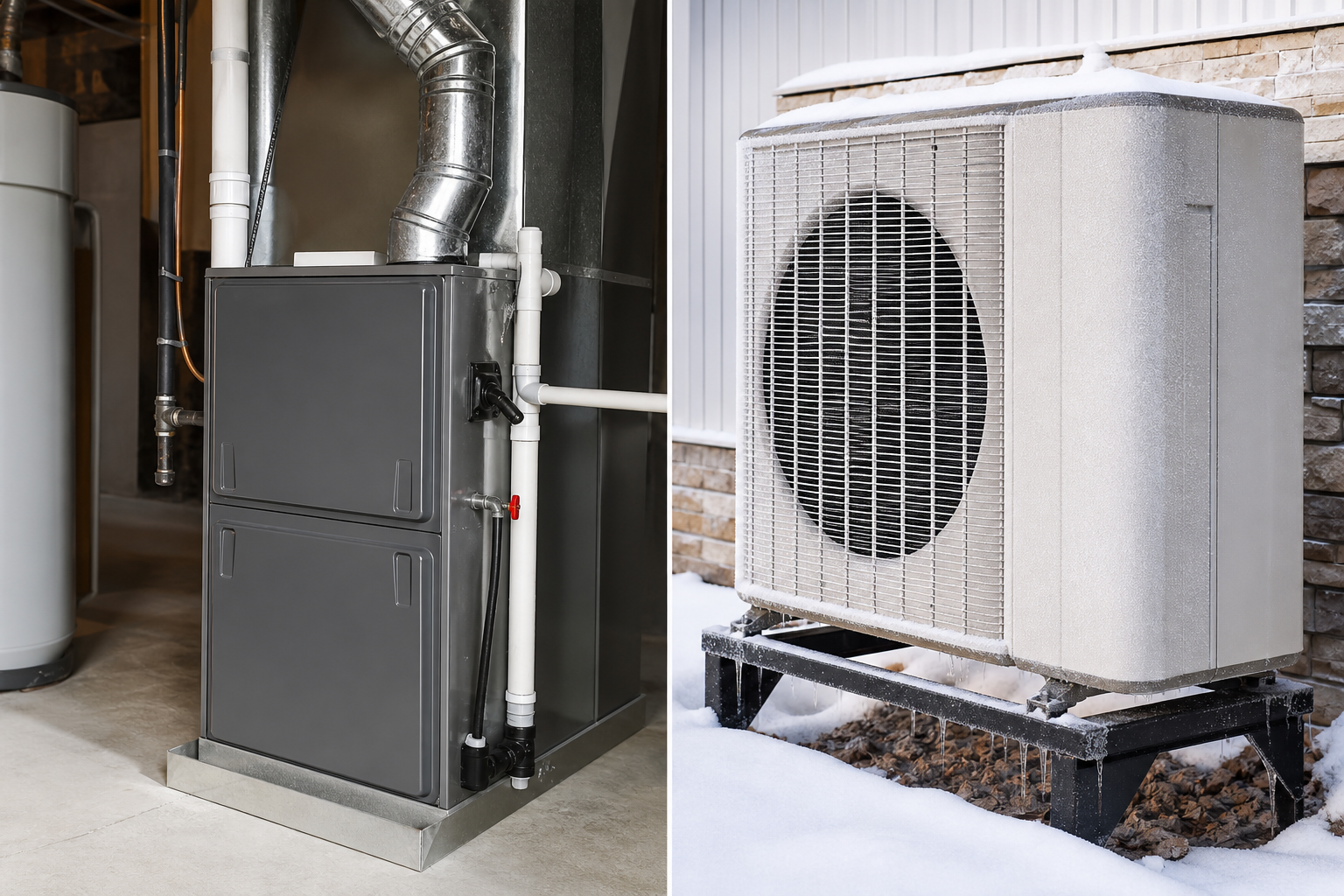
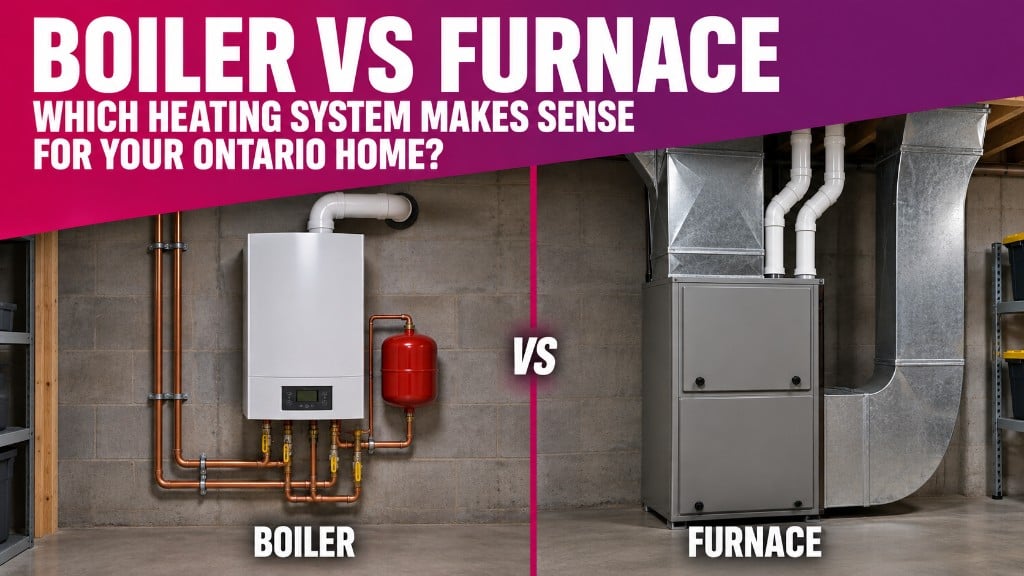
When comparing a boiler vs furnace, the biggest difference is how each system moves heat through your home.
A furnace heats air and distributes it through ducts and registers.
A boiler heats water and moves that heated water through pipes to radiators, baseboards, radiant floors, or other hydronic heating equipment.
Neither system is automatically the right choice for every Ontario home.
If your house already has good ductwork and central air conditioning, a furnace may be the simpler heating system to install and integrate.
If your home already has radiators, hydronic baseboards, or in-floor heating, replacing an existing boiler with another properly sized boiler can make much more sense than rebuilding the home’s heating distribution system.
The right answer depends on your home, existing heating system, fuel source, insulation, comfort preferences, cooling needs, and the condition of the equipment already installed.
The Gravity Group installs, repairs, and maintains furnaces, boilers, heat pumps, and other residential heating systems throughout Peterborough, Lindsay, Kawartha Lakes, and surrounding communities. Gravity also provides 24/7 heating service when a system stops working.
Need help with a boiler or furnace?
Call The Gravity Group at 705-344-6835. We answer 24/7.
Quick Answer: Boiler vs Furnace — What’s the Difference?
A furnace heats air. A boiler heats water.
A furnace pushes heated air through ducts using a blower. A boiler circulates heated water through pipes to radiators, hydronic baseboards, radiant floors, or similar equipment.
Natural Resources Canada describes forced-air furnaces as Canada’s most common type of central heating system. Hydronic systems use a boiler or approved water-heating appliance to heat water and circulate it through the home.
| Feature | Furnace | Boiler |
|---|---|---|
| Heat transfer | Heated air | Heated water |
| Distribution | Ductwork | Pipes |
| Common terminals | Registers and vents | Radiators, baseboards, radiant floors |
| Central AC integration | Usually straightforward | Requires separate cooling system or other solution |
| Air filtration | Can use central HVAC filtration | Does not circulate household air through heating ducts |
| Humidification | Can integrate central humidifier | Requires separate humidity solution |
| Zoning | Available with proper duct/control design | Often well suited to multiple hydronic zones |
| Existing-home fit | Strong fit where ducts already exist | Strong fit where hydronic piping already exists |
| Typical Canadian use | Very common | Common in older homes and hydronic applications |
The most important question usually isn’t “which technology is better?” It’s “which system fits this house and the way the house already distributes heat?”
What Is a Furnace?
A furnace is a forced-air heating appliance.
In a typical natural gas furnace system: the thermostat calls for heat, the furnace begins its ignition sequence, the burners produce heat, the heat exchanger transfers that heat to circulating household air, the blower pushes heated air into supply ducts, warm air enters rooms through registers, and cooler household air returns through return-air ductwork. The cycle continues until the thermostat is satisfied.
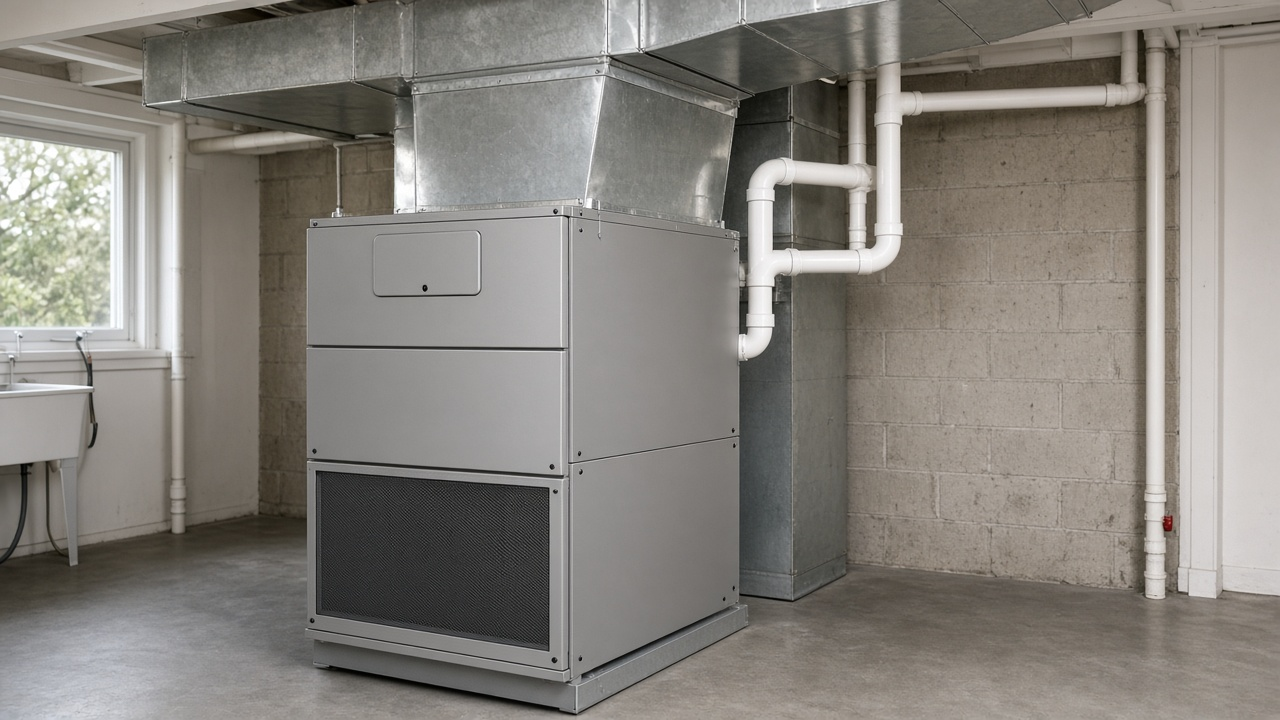
In a properly functioning forced-air gas furnace, combustion gases and household air remain separate. Combustion products leave through the venting system while the blower circulates household air through the duct system.
Modern forced-air systems can also support central air conditioning, heat pumps, whole-home humidifiers, air filtration, HRV or ERV integration, zoned HVAC controls, and variable-speed airflow.
This ability to use one distribution network for heating, cooling, filtration, and ventilation is one reason furnaces remain common in Canadian homes.
What Is a Boiler?
A boiler is the heat source in a hydronic heating system. Instead of heating air, the boiler heats water. That heated water travels through pipes to heating terminals around the home.
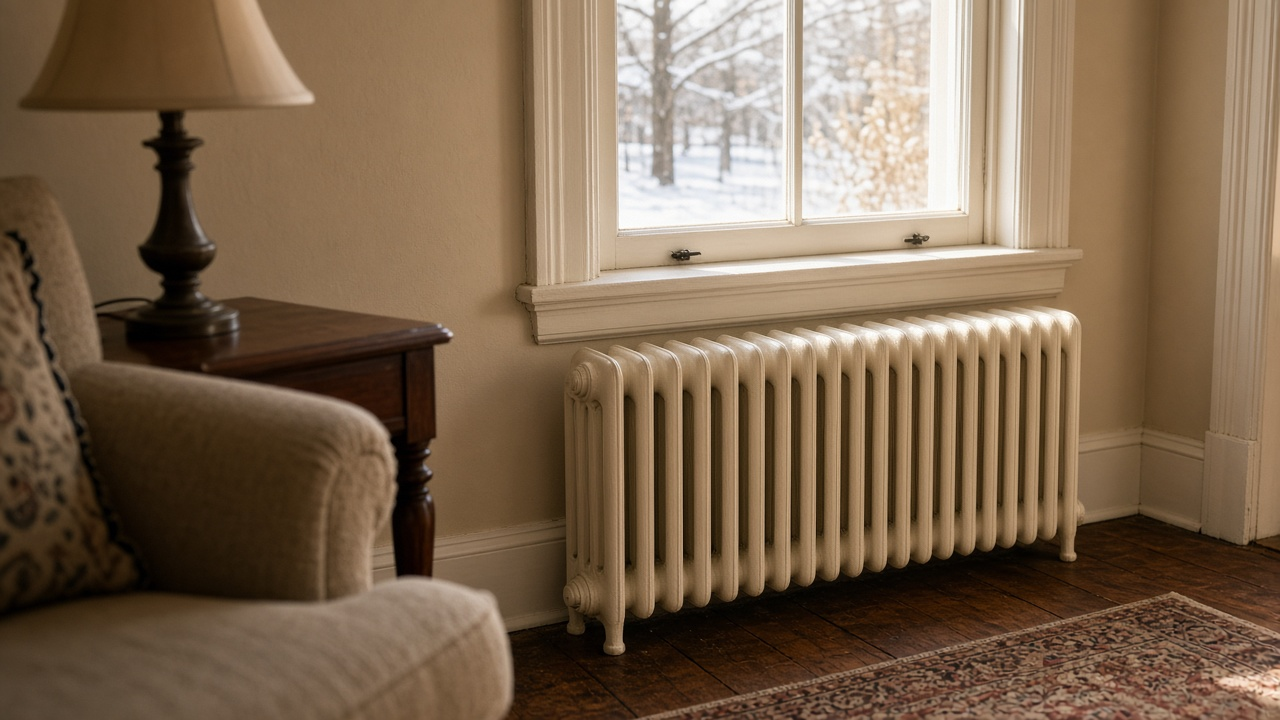
These may include cast-iron radiators, modern panel radiators, hydronic baseboards, radiant floor tubing, fan coils, or other hydronic emitters. The water gives off heat and then returns to the boiler to be heated again.
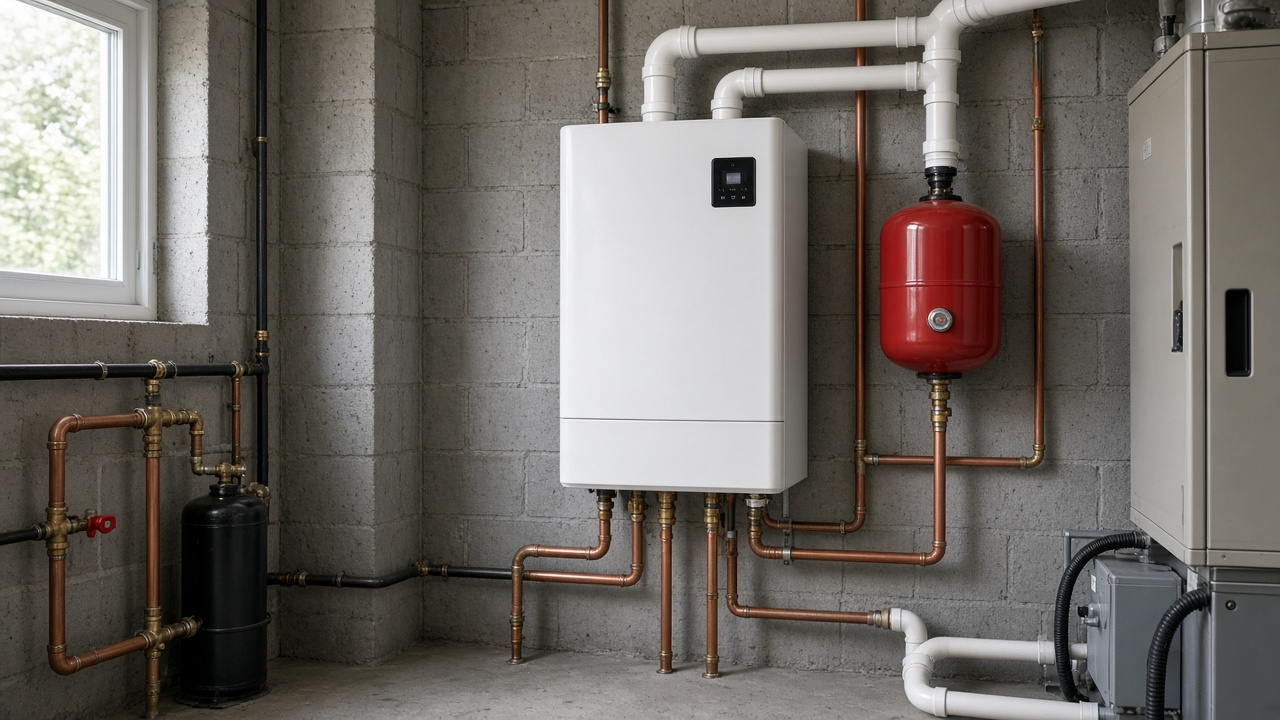
Older Ontario homes may still have large cast-iron radiators and older boilers. Newer hydronic systems can use compact boilers, modulating boilers, multiple heating zones, in-floor radiant systems, outdoor reset controls, high-efficiency pumps, and modern plastic or copper hydronic piping.
The basic idea is still the same: heat water, move the water, let the water release heat into the home.
Not sure which system you have — or need?
Call Gravity at 705-344-6835. We’ll look at your home and explain your options.
Boiler vs Furnace: Which Gives More Comfortable Heat?
Comfort is subjective, but the two systems feel different.
Furnace heat
A furnace delivers warm air through registers. That can heat a house relatively quickly. Modern two-stage, modulating, and variable-speed systems can reduce the temperature swings associated with older single-stage furnaces.
But you may notice air movement, register noise, short periods of hotter air near vents, cooler periods between cycles on older equipment, and greater room-to-room differences if ductwork is poorly balanced.
Boiler heat
Hydronic systems transfer heat through surfaces such as radiators, baseboards, or floors. That can create a different comfort profile — heat from surfaces rather than a stream of warm air from a register.
A badly designed boiler system can still heat poorly. A properly designed furnace can still provide very good comfort.
Does a Boiler Heat a House More Evenly Than a Furnace?
It can, particularly when the hydronic system is well designed and properly balanced. Because there is no central blower switching large volumes of warm air on and off, some homeowners perceive hydronic heat as steadier.
That does not mean every boiler home has perfectly even temperatures. Common hydronic problems include air trapped in radiators, poor zone design, incorrect water temperatures, failed circulator pumps, improper balancing, undersized radiators, and old controls.
A furnace home’s comfort depends heavily on duct design. A powerful furnace cannot compensate for poor ductwork.
Boiler vs Furnace Efficiency
This is where comparisons often become misleading. A boiler is not automatically more efficient than a furnace. A furnace is not automatically cheaper to run than a boiler.
The answer depends on equipment efficiency, fuel, building heat loss, equipment sizing, controls, distribution system, maintenance, local energy prices, and how the system operates.
Natural Resources Canada states that an ENERGY STAR certified gas boiler can use about 10% less energy than a standard gas boiler, while an ENERGY STAR certified gas forced-air furnace can use about 6% less energy than a standard furnace. Those figures compare certified equipment against standard equipment within the same category — they do not mean boilers are inherently more efficient than furnaces.
Compare actual equipment ratings and expected whole-home performance instead of simply comparing the words boiler and furnace.
What Is AFUE?
When comparing fuel-burning furnaces and boilers, you’ll often see AFUE — Annual Fuel Utilization Efficiency. It represents the portion of fuel energy converted into useful heat over a typical heating season.
For example, a 95% AFUE furnace is rated to convert approximately 95% of its fuel energy into useful heat under standardized testing conditions.
AFUE helps compare equipment. It does not tell you what your total heating bill will be. Your actual heating costs also depend on weather, thermostat settings, house size, insulation, air leakage, fuel cost, duct or pipe losses, equipment sizing, maintenance, and occupant habits.
Condensing Boilers vs Conventional Boilers
Modern high-efficiency gas boilers often use condensing technology to recover additional heat from combustion gases. This works best when return-water temperatures are low enough for the appliance to condense water vapour and capture that extra heat.
That is why modern condensing boilers can be particularly well suited to radiant floors, properly sized low-temperature radiators, and systems designed around lower water temperatures.
Older hydronic systems may have been designed around much hotter water. That doesn’t automatically rule out a condensing boiler — but the contractor needs to understand existing radiation, required supply-water temperature, outdoor design temperature, heat loss, and control strategy.
Simply hanging a high-efficiency boiler on the wall does not automatically produce high-efficiency operation. System design matters.
Boiler vs Furnace: Which Heats a House Faster?
A furnace usually produces a faster sensation of heat because heated air begins moving through the home shortly after the blower starts. This can be useful when recovering from a thermostat setback.
Hydronic systems often respond more slowly, especially radiant floors, large cast-iron radiators, and high-mass systems. But slower does not necessarily mean worse — high-mass heating systems often maintain temperature steadily once they are operating.
Think of it this way: a furnace can react quickly; a hydronic system can retain and release heat for longer.
Boiler vs Furnace: Which Is Quieter?
A boiler system can be quieter inside living spaces because it does not require a large central blower pushing air through ductwork. You may still hear the boiler burner, circulator pumps, expansion noises in pipes, radiator noises, and valves opening and closing.
A furnace can also operate quietly, particularly with variable-speed ECM blowers, good duct design, proper equipment sizing, and properly sized return ducts. If a furnace is loud enough that you hear roaring airflow throughout the house, the problem may involve the duct system or equipment sizing rather than furnaces as a category.
Heating uneven, loud, or inefficient?
Call 705-344-6835 for furnace or boiler diagnosis across Peterborough, Lindsay and Kawartha Lakes.
Boiler vs Furnace for Indoor Air Quality
This topic needs some nuance.
A furnace circulates air through the HVAC system — creating an opportunity to add central filtration, media filters, humidifiers, HRV/ERV integration, and other indoor air quality equipment. But the duct system can also redistribute dust, odours, pet hair, and other airborne material.
A typical hydronic system circulates water rather than household air. That means the boiler itself does not repeatedly move room air through a central heating duct network — but it also does not give you central HVAC filtration by itself.
So the answer is not “boilers have better indoor air quality.” The better answer is: boilers don’t circulate household air through heating ducts, while forced-air systems can incorporate central filtration and ventilation equipment.
Boiler vs Furnace for People With Allergies
People sometimes assume hydronic heating is always better for allergies because it does not use a blower. That is too broad.
A well-designed forced-air HVAC system with good filtration and ventilation can provide strong indoor air quality. A boiler-heated home with poor ventilation or moisture problems can still have bad indoor air. Choose the heating system based on the whole building, not one assumption.
Furnace Advantage: Heating and Cooling Through the Same Ducts
This is one of the biggest practical differences.
If your house already has forced-air ductwork, the same duct system can often support furnace heating, central air conditioning, a central heat pump, filtration, humidification, and ventilation.
A boiler does not provide cooling through radiators or conventional hydronic baseboards. If your home has a boiler and you want air conditioning, options may include ductless mini-split heat pumps, multi-zone ductless systems, separate ducted air conditioning, air handlers or fan coils, or other HVAC designs.
Removing a working hydronic system solely because you want cooling may not always be the most practical approach. Sometimes keeping the boiler and adding ductless cooling makes more sense. Sometimes installing ductwork and converting the whole home makes sense. The house needs to be assessed.
Related reading: should you buy a new air conditioner or furnace and gas furnace or heat pump: which is best.
Can a Boiler Provide Hot Water Too?
Some boiler systems can supply space heating, domestic hot water, radiant floor heating, and other hydronic loads. But not every boiler supplies domestic hot water.
A home may have a boiler plus a separate water heater, a boiler plus an indirect hot-water tank, a combination boiler, or another configuration. If your existing boiler also heats your domestic water, replacing it affects two systems rather than one.
What Is a Combi Boiler?
A combination boiler, commonly called a combi boiler, combines space heating and domestic hot water into one appliance. Instead of using a separate traditional hot-water tank, the combi boiler can produce domestic hot water as required.
Combi systems can reduce the number of large mechanical appliances in some homes — but they need to be sized carefully. Large households with multiple showers running at the same time can have very different hot-water requirements from a smaller household.
Do not choose a combi boiler based only on the advertised maximum heating output.
Boiler vs Furnace for Older Ontario Homes
This is where boilers can make a lot of sense. Many older homes were built with hydronic heating — cast-iron radiators, hydronic baseboards, boiler piping, and multiple heating zones.
If that system is structurally sound, replacing an old boiler with a modern unit can let you keep the existing distribution system. Converting the same home to forced air could require new supply and return ducts, bulkheads, wall openings, floor penetrations, mechanical-room changes, and major finishing work.
In these houses, the existing heating infrastructure carries real value. Do not remove it automatically.
Should You Replace an Old Boiler With a Furnace?
Sometimes. But this should be a building decision rather than an appliance decision.
Ask: Are the existing radiators and piping in good condition? Do you like hydronic comfort? Do you want central air conditioning? Is there space for ductwork? Would installing ducts require major renovations? Are you planning a large renovation anyway? What will boiler replacement cost versus a full furnace-and-duct conversion? Do you want a heat pump?
If your existing hydronic system works well apart from an old boiler, boiler replacement may be the simpler path. If the house is already being gutted and you want central forced-air heating and cooling, that can change the economics.
Should You Replace an Old Furnace With a Boiler?
This is less common. If your home already has functional ductwork, installing an entirely new hydronic distribution system means adding a boiler, pumps, controls, piping, and radiators or radiant floors — a substantial retrofit.
Boiler conversion can make sense as part of a major renovation, new custom home, large radiant-floor project, addition, or specific comfort plan. Replacing a furnace with a boiler solely because boilers sound appealing rarely makes sense without considering installation costs.
Planning a boiler or furnace replacement?
Call 705-344-6835 for a quote that fits your home — not just the old equipment size.
Boiler vs Furnace Installation Cost
There is no useful single price for every Ontario home. Cost depends on the project.
Furnace installation costs can change based on furnace size, efficiency level, staging or modulation, blower technology, venting, gas piping, electrical work, duct changes, air-conditioning integration, existing equipment removal, and mechanical-room conditions.
Boiler installation costs can change based on boiler capacity, efficiency, number of zones, pumps, controls, venting, gas piping, expansion tank, air separator, existing radiators, hydronic piping, domestic hot-water integration, combi configuration, radiant floor requirements, and chimney or venting changes.
A simple furnace swap in a house with good ductwork is very different from installing new ducts throughout an older home. A boiler swap using good existing piping is very different from building a radiant heating system from scratch.
Boiler vs Furnace Operating Cost
Operating cost depends heavily on fuel price, equipment efficiency, home heat loss, thermostat settings, heating load, maintenance, and distribution losses. Statements such as “boilers are cheaper to run” or “furnaces always cost less” are unreliable.
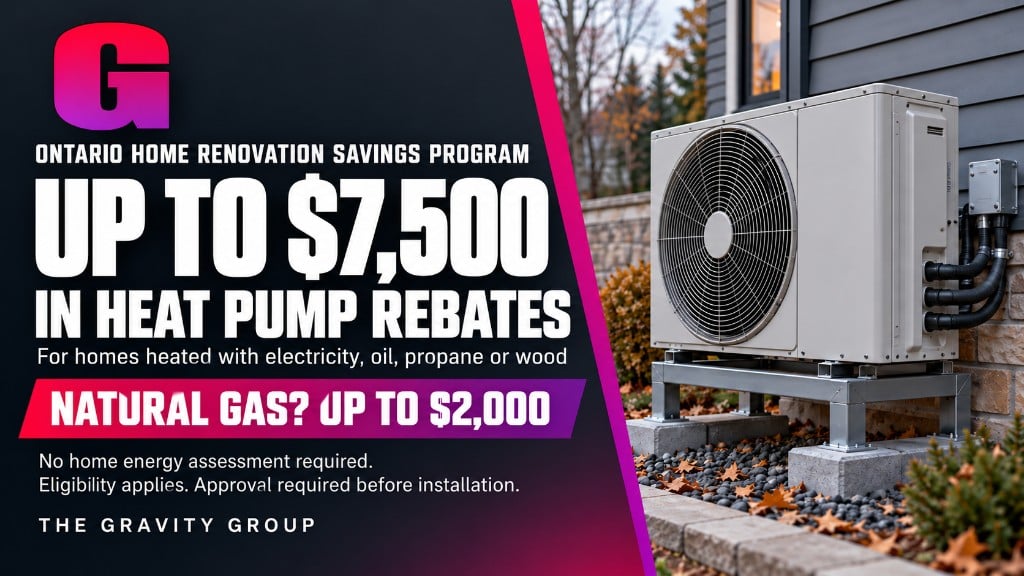
If energy cost is the main concern, a cold-climate heat pump should also be part of the conversation. Gravity services furnaces, boilers, and heat pumps — so homeowners do not need to limit the comparison to only two technologies. See Ontario heat pump rebates if you are considering a qualifying cold-climate system.
Boiler vs Furnace Maintenance
Neither system is maintenance-free.
A furnace may require attention to the filter, blower, burner, ignition, flame sensor, heat exchanger, venting, condensate system, electrical controls, duct airflow, and thermostat. Homeowners can usually handle basic filter replacement. Pre-season tips: prepare your furnace for winter in Ontario.
A boiler system may require attention to the burner, heat exchanger, circulator pumps, expansion tank, pressure, air elimination, zone valves, venting, controls, piping, radiators, and condensate components on condensing equipment.
Common Furnace Problems
Common furnace service calls include furnace not starting, short cycling, weak airflow, dirty filter, ignition failure, flame sensor problems, blower problems, thermostat issues, overheating, venting problems, no heat, and unusual noises.
If your furnace keeps starting and stopping, see why a furnace keeps turning on and off.
Common Boiler Problems
Boilers fail differently because they use water as the distribution medium. Common problems can include boiler not firing, no heat, low system pressure, circulator pump failure, a zone not heating, air trapped in radiators, expansion tank problems, leaking components, valve failure, control problems, strange pipe or radiator noises, uneven heating, venting problems, and condensate issues on condensing equipment.
If one room or zone stays cold while the rest of the home heats normally, the problem may be within that zone rather than the entire boiler. Replacing the boiler will not fix a closed valve or failed zone circulator somewhere else in the system.
Boiler Leaking Water: Is That Serious?
A boiler system contains pressurized water. A visible leak deserves attention. Potential sources include the relief valve, circulator, expansion tank, pipe connection, heat exchanger, air vent, drain, valve, or corroded piping.
Do not keep adding water to a boiler system indefinitely without finding out why pressure keeps falling. The water is going somewhere.
Furnace vs Boiler: Which Lasts Longer?
There is no reliable single lifespan that applies to every boiler or furnace. Service life depends on equipment quality, installation, water quality, maintenance, usage, cycling, sizing, venting, operating conditions, and component history.
Age matters. Condition matters more. If you’re deciding between another major repair and replacement, ask for an assessment of the entire system rather than relying only on the manufacturing date.
Is a 20-Year-Old Boiler or Furnace Worth Replacing?
Possibly. Age alone does not make the decision.
Ask whether the equipment is reliable, leaking, or suffering a major heat-exchanger problem; whether parts remain available; whether repairs keep stacking up; whether comfort and fuel use are acceptable; whether venting is still appropriate; and whether you are planning renovations.
A 20-year-old system with a major failure deserves a different conversation from a 20-year-old system that needs a minor service call.
Repair or replace — need a straight answer?
Call Gravity at 705-344-6835. We’ll diagnose first, then explain repair vs replacement options.
Which System Works Better With Multiple Heating Zones?
Hydronic systems are often well suited to zoning through zone valves, multiple pumps, separate thermostats, and different water-temperature circuits. Forced-air systems can also be zoned with motorized dampers and zone controls — but badly designed forced-air zoning can create static-pressure and airflow problems.
Which Is Better for Radiant Floor Heating?
A boiler or other hydronic heat source is the natural fit for traditional water-based radiant floor heating. Warm water circulates through tubing installed beneath or within the floor. Radiant floor systems typically operate at lower water temperatures than older cast-iron radiator systems, which can pair well with condensing boiler technology when properly designed.
Can a Heat Pump Work With a Boiler System?
Yes, depending on the design. One option is to keep the boiler for heating and add ductless heat pumps for cooling, shoulder-season heating, or supplemental winter heating. Another possibility is an air-to-water heat pump that supplies a hydronic system.
Natural Resources Canada notes that air-to-water heat pumps can feed lower-temperature hydronic systems such as radiant floors and fan coils. The right design depends on the existing equipment.
Boiler vs Furnace Safety
Gas- and oil-fired boilers and furnaces are combustion appliances. They require proper combustion, correct venting, adequate combustion air, safe installation, and routine service.
Ontario also expanded carbon monoxide alarm requirements on January 1, 2026. Homes with fuel-burning appliances must have working CO alarms adjacent to sleeping areas and, under the updated rules, on every storey.
Leave the home. Call emergency services from outside. Do not remain inside trying to identify the appliance causing the alarm.
Boiler vs Furnace: Which Makes More Sense for Your Home?
A furnace may make sense when your home already has ductwork, you want central air conditioning, central filtration, or whole-home humidification, existing ductwork is in good condition, and you want heating and cooling through one air-distribution system.
A boiler may make sense when your home already has hydronic piping, radiators, or hydronic baseboards; you want radiant floor heating; you prefer hydronic heating; or installing full ductwork would require major construction.
You should compare other options when your existing system needs complete replacement, you are doing a major renovation, you want to reduce fuel use, you need new cooling equipment anyway, you are considering a cold-climate heat pump, or you want a hybrid heating system.
Furnace vs Boiler for a Peterborough Century Home
Older Peterborough homes can create interesting heating decisions — original radiator heating, older boilers, brick construction, plaster walls, limited space for ducts, renovated additions, mixed windows, and multiple heating zones.
If the radiator system is in good condition, keeping hydronic heat can avoid invasive duct installation. If the house already has ducts from previous renovations, central forced-air or heat-pump options may become easier. There is no useful answer based on the home’s age alone.
Boiler vs Furnace for Kawartha Lakes and Rural Homes
Rural homes introduce other considerations: natural gas, propane, oil, electricity, wood backup, heat pump, generator, rural electrical service, large additions, walkout basements, and cottage conversions. Fuel availability can affect the decision as much as equipment efficiency.
What Should a Heating Contractor Check Before Replacing a Boiler or Furnace?
A replacement should not start with “what size is the old unit?” The contractor should look at building heat loss, existing equipment capacity, duct sizing or hydronic radiation, fuel source, venting, electrical service, thermostat and controls, insulation, windows, renovations, additions, cooling needs, hot-water requirements, existing zoning, and mechanical-room space.
Oversizing can create comfort and efficiency problems. Proper sizing comes first.
Boiler vs Furnace: Repair or Replace?
A breakdown doesn’t automatically mean replacement. Repair may make sense when equipment is otherwise in good condition, the failure is isolated, parts remain available, repair cost is reasonable, the system still heats properly, and breakdowns are uncommon.
Replacement deserves consideration when major components fail, repairs keep stacking up, equipment is significantly oversized, comfort remains poor, venting needs major work, parts are hard to source, fuel consumption is high, you are already planning HVAC renovations, or a new system would solve several problems at once.
Boiler or furnace not heating?
Call 705-344-6835. Gravity provides 24/7 heating service across Peterborough, Lindsay and Kawartha Lakes.
Frequently Asked Questions About Boilers vs Furnaces
What is the main difference between a boiler and a furnace?
A furnace heats air and distributes it through ducts. A boiler heats water and circulates it through pipes to radiators, baseboards, radiant floors, or other hydronic heating equipment.
Is a boiler more efficient than a furnace?
Not automatically. Modern boilers and furnaces are available in high-efficiency configurations. Actual efficiency depends on equipment rating, sizing, controls, installation, fuel, distribution losses, and home heat loss.
Which is cheaper to run, a boiler or furnace?
There is no universal answer. Operating cost depends on fuel price, equipment efficiency, home heat loss, thermostat settings, maintenance, and system design.
Which is cheaper to install?
A furnace replacement can be relatively straightforward when usable ductwork already exists. A boiler replacement can be relatively straightforward when usable hydronic piping and radiators already exist. Converting from one distribution system to the other can add substantial construction cost.
Can a boiler cool my home?
A conventional boiler does not provide air conditioning through radiators or hydronic baseboards. Boiler-heated homes commonly use separate cooling such as ductless heat pumps or a separate ducted system.
Can a furnace provide air conditioning?
The same ductwork used by a furnace can usually support a central air conditioner or ducted heat pump when the system is properly designed.
Does a boiler use ductwork?
No. A conventional hydronic boiler system distributes heat through water pipes rather than forced-air ducts.
Does a furnace use water?
A typical forced-air gas furnace does not use water to distribute heat through the house. High-efficiency furnaces can produce condensate as part of the combustion and venting process.
Is radiant floor heat a boiler system?
Hydronic radiant-floor systems commonly use a boiler or another water-heating source to circulate warm water through tubing beneath the floor.
Can I replace my boiler with a furnace?
Yes, but you will need a way to distribute the furnace’s heated air. If the home does not have ductwork, installing a furnace may require substantial duct construction.
Can I replace a furnace with a boiler?
Yes, but converting from forced air to hydronic heating requires piping plus radiators, baseboards, radiant floors, or other hydronic equipment. This is usually a much larger project than a basic equipment replacement.
Are boilers good for old houses?
They can be. Many older houses already have hydronic piping and radiators, which can make boiler replacement practical. The condition of the existing system should be inspected first.
Are boilers quieter than furnaces?
Hydronic systems often produce less air-distribution noise because they do not use a central blower and duct network for heating. Pumps, pipes, valves, and the boiler itself can still make noise.
Which system is better for allergies?
Boilers do not circulate household air through heating ducts. Forced-air systems can circulate dust but can also use central filtration and ventilation equipment. Indoor air quality depends on the complete home and HVAC setup.
Can a boiler provide domestic hot water?
Some boiler systems can. Options include indirect tanks and combination boilers that provide space heating and domestic hot water.
How often should a boiler or furnace be serviced?
Service requirements depend on equipment and fuel. Natural Resources Canada recommends regular professional maintenance and notes that oil-fired equipment generally needs annual cleaning and tuning, while natural gas and propane equipment should receive periodic professional service.
Do I need carbon monoxide alarms with a gas boiler or furnace?
Yes. Ontario’s current Fire Code requires CO alarms in homes with fuel-burning appliances, with expanded placement requirements in effect since January 1, 2026.
Who repairs boilers and furnaces in Peterborough and Kawartha Lakes?
The Gravity Group provides boiler, furnace, heat pump, and residential heating service throughout Peterborough, Lindsay, Kawartha Lakes, and surrounding areas, including 24/7 heating service. Call 705-344-6835.
Boiler or Furnace Giving You Trouble? Call Gravity
The right heating system is the one that fits your home.
If you already have good ductwork, a furnace may be the practical choice. If you already have a good hydronic distribution system, a boiler may make far more sense.
If your current heating system is near the end of its service life, it is also worth comparing modern heat pumps and hybrid systems before automatically replacing old equipment with the same technology.
The Gravity Group repairs, installs, and maintains furnaces, boilers, heat pumps, hydronic heating, and residential HVAC systems across Peterborough, Lindsay, Kawartha Lakes, and surrounding communities.
Always Available. Always Reliable. Always Answers The Phone.
Need heating service? Call Gravity at 705-344-6835
Boiler, furnace, or heat pump help — we answer 24/7.
Ready for next steps?
Book service, ask about financing, or browse protection plans — we are always available.