
A whole-home humidifier in Ontario can make sense when your house stays dry through heating season. Static shocks, shrinking woodwork and constantly running portable humidifiers are clues — but a humidity reading is a better starting point than guesswork.
For homeowners in Peterborough, Lindsay and Kawartha Lakes, the challenge is balance. Some homes need added moisture; others already have wet windows and too much humidity.
The goal is comfortable indoor air without condensation. Your outdoor temperature, windows, ventilation and heating system all influence what works.
House feeling too dry this winter?
Call Gravity at 705-344-6835 for whole-home humidifier installation, maintenance and humidity-control advice. We answer the phone 24/7.
Quick Answer: Do You Need a Whole-Home Humidifier?
Consider one if a hygrometer repeatedly shows low indoor humidity and dryness affects several rooms. A central system may be more convenient than refilling multiple portable units. A reading below 30% is a reason to investigate, not an automatic instruction to add moisture during extreme cold.
| What you notice | What to do next |
|---|---|
| Persistently low readings, static and dry woodwork | Measure for several days and assess whether controlled humidification would help. |
| Only one dry bedroom | A properly maintained portable humidifier may be enough. |
| Wet windows, interior frost or musty smells | Investigate excess moisture and ventilation before adding humidity. |
| A new furnace but comfortable humidity | You may not need a humidifier at all. |
What Is a Whole-Home Humidifier?
A whole-home humidifier adds controlled moisture to air distributed through your HVAC ducts. Most systems include a water connection, humidity control, duct connection and, where required, a drain and electrical supply.
Depending on the design, it operates with a heating call, blower operation or a humidity demand. Gravity’s indoor air quality services include humidifiers integrated with residential HVAC systems.
Why Do Ontario Homes Get So Dry in Winter?
Cold outdoor air typically contains little water vapour. When that air enters your home and warms up, its relative humidity drops unless moisture is added. Air leaks and ventilation can keep bringing in more dry outdoor air throughout winter.
Relative humidity, or RH, describes how close air is to saturation at its current temperature. A reading of 35% RH means the water-vapour level is about 35% of saturation at that temperature.
Your furnace heats the air; it does not simply “burn moisture out.” A new high-efficiency furnace does not automatically create a dry house. Measure before assuming the equipment is the cause.
What Should Indoor Humidity Be in an Ontario Winter?
Health Canada’s moisture and mould guidance recommends a general indoor RH range of 30% to 50%. Its guidance for indoor air quality professionals advises around 30% in colder weather, depending on what the building can tolerate without condensation.
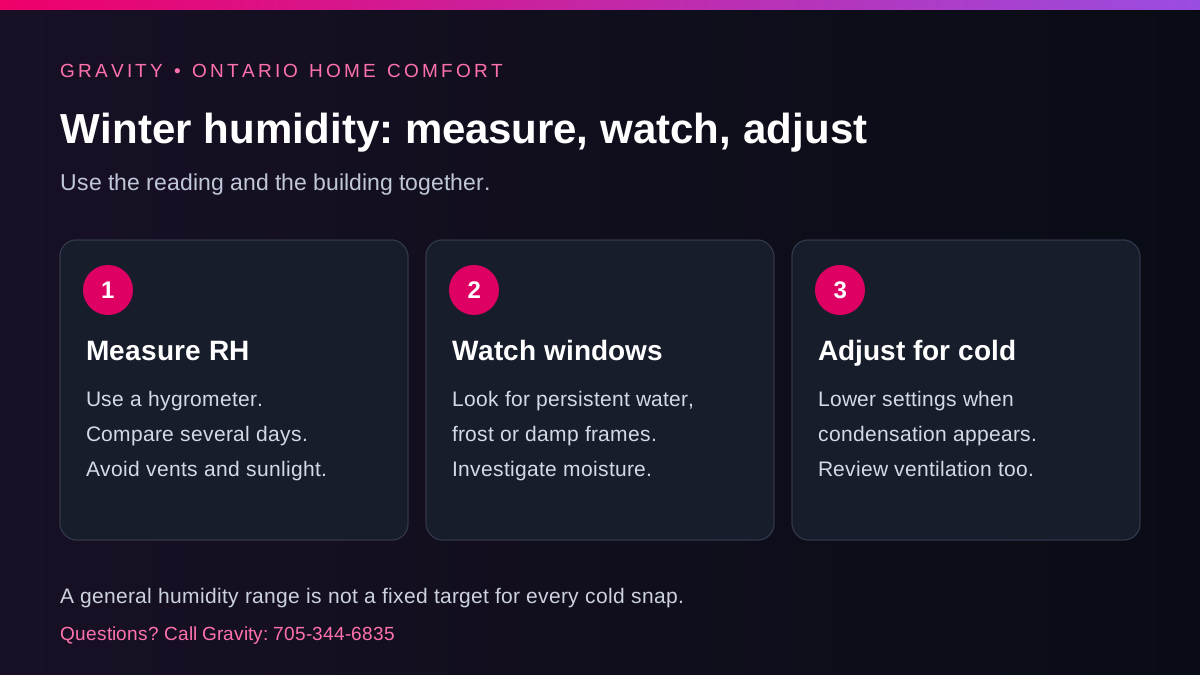
Around 30% to 35% can be a useful winter starting point for many homes. It is not a fixed target for every house or every temperature. Older windows and very cold weather may require lower settings.
A setting that works on a mild day may cause condensation during a cold snap. Lower the humidistat if persistent water or frost appears on interior windows, and investigate ongoing moisture problems.
Your Windows Are a Useful Warning System
Window surfaces get colder as outdoor temperatures fall. Moist indoor air touching cold glass can condense, even when the same humidity setting caused no trouble the previous week.
- Persistent water droplets or frost on interior glass
- Wet frames, sills or nearby finishes
- Peeling paint, staining or recurring mould around windows
Brief condensation after showering or cooking can be temporary. Widespread or persistent moisture deserves attention. Reduce added humidity, use appropriate exhaust ventilation and have persistent problems assessed.
There is no universal outdoor-temperature chart that guarantees safe humidity for every window and wall assembly. Window construction, curtains, airflow and indoor temperature all affect the result.
8 Signs Your Home May Be Too Dry
1. Constant static electricity
Frequent static shocks can accompany dry indoor air. Combine that clue with measured RH before choosing equipment.
2. Dry skin feels worse indoors
Low humidity may contribute to discomfort, but skin irritation has many causes. Humidification is a comfort measure, not medical treatment.
3. Your nose or throat feels dry
Measure the air rather than diagnosing the home from symptoms alone. Persistent discomfort can have causes unrelated to humidity.
4. Hardwood floors develop seasonal gaps
Wood releases moisture and can shrink during a dry heating season. Follow flooring-manufacturer humidity guidance and avoid excessive humidity too.
5. Doors, trim or furniture change with the season
Opening joints and changing door fit can be clues to moisture changes. They do not prove a humidifier is the only solution.
6. Wooden instruments need extra attention
Pianos and acoustic instruments respond to humidity changes. Follow their care requirements; some need local humidity control even with a central system.
7. Several portable humidifiers run constantly
Daily refilling and cleaning across several rooms may make a whole-home system worth comparing.
8. A hygrometer repeatedly confirms low RH
Place a monitor in a typical living space away from supply registers, exterior doors, showers and direct sunlight. Compare readings over several days.
Measure first. Choose equipment second.
Gravity can assess your indoor humidity, ductwork and ventilation before recommending a humidifier. Call 705-344-6835 or request a quote.
Whole-Home Humidifier vs Portable Humidifier
| Feature | Portable humidifier | Whole-home humidifier |
|---|---|---|
| Coverage | Usually one room or a limited area | Multiple rooms through suitable ductwork |
| Upfront cost | Generally lower | Higher, including installation |
| Water supply | Usually a refillable tank | Usually connected to household water |
| Daily attention | Refilling and cleaning | Less refilling work; still needs maintenance |
| Control | Local settings and room conditions | Central humidistat; automatic options available |
| Best fit | A single dry room | Persistent dryness across a ducted home |
Neither option is maintenance-free. Portable units need cleaning according to their instructions; central equipment needs water-panel, drain and control checks appropriate to its design.
Three Types of Whole-Home Humidifiers
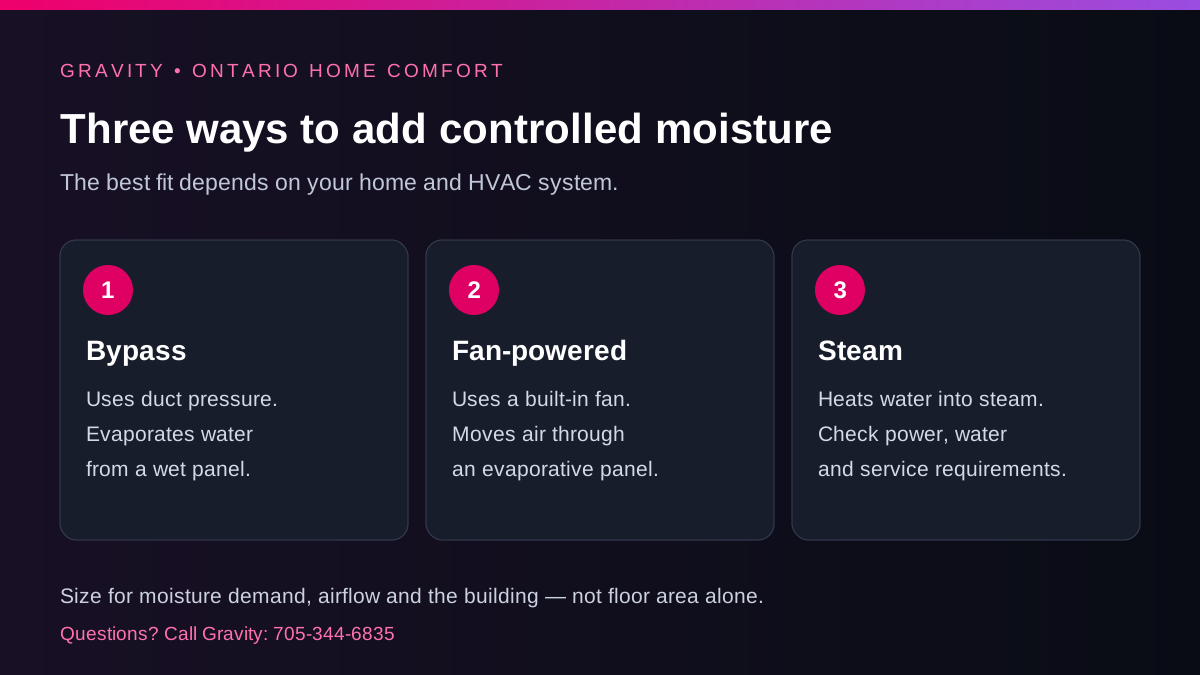
1. Bypass humidifier
A bypass humidifier uses the pressure difference in the duct system to move air across a wet evaporative panel. It is a common option where suitable bypass ductwork, water supply and drainage can be installed. Output depends on the model, airflow, temperature and runtime.
2. Fan-powered humidifier
A fan-powered model uses its own fan to move air through the evaporative panel. It can suit layouts where bypass ducting is awkward. It still needs a compatible mounting location, controls, water supply, power and any specified drain.
3. Steam humidifier
Steam units generate moisture by heating water. They can provide substantial output without relying as heavily on hot furnace air, but generally involve higher equipment and installation costs. Electrical capacity, water requirements and canister maintenance need checking.
Which Humidifier Is Best for Your Home?
There is no universal winner. The right capacity depends on how much moisture the home loses, its size and construction, ventilation, HVAC runtime and the humidity target the building can tolerate.
A large, airtight home does not necessarily need more moisture than a smaller, leaky one. Occupancy and ventilation matter alongside floor area.
- Current RH readings and condensation history
- Furnace or heat-pump operation and airflow
- Supply and return duct space
- Water quality, drainage and electrical capacity
- Maintenance expectations and installed cost
Can You Add a Humidifier to Any Furnace or Heat Pump?
Many forced-air systems can accommodate humidification, but the installer must check ductwork, mounting clearances, controls and service access. It is not simply a matter of attaching a box to any available surface.
Heat pumps often deliver lower supply-air temperatures than gas furnaces. That can affect evaporative output. Steam may suit some applications, but every heat-pump home does not automatically need it.
If your home uses a boiler, radiators or electric baseboards without central ducts, a standard furnace-mounted installation may not be suitable. Independent or room-based options need a different assessment.
For broader equipment planning, see Gravity’s furnace services and HVAC services. If the heating system repeatedly shuts down, read our furnace short-cycling guide; adding humidity will not fix a heating fault.
Will a Humidifier Make the House Warmer or Lower Heating Bills?
Balanced humidity may improve comfort, but a humidifier does not replace heating. Your thermostat still controls temperature, and the humidifier may use water and electricity.
Do not base the purchase on promised heating savings. Operating costs depend on the equipment, runtime, utility rates and your house. The strongest reason to install one is a confirmed humidity problem.
Manual vs Automatic Humidity Controls
A manual humidistat lets you select the humidity setting yourself. During a cold snap, you may need to lower it to prevent condensation.
An outdoor-sensing automatic control can adjust the target as weather changes. It still needs proper setup, a suitable sensor location and occasional checks against actual conditions in your home.
Turn the humidity setting down and monitor the result. Recurring frost, damp finishes or musty smells need investigation; do not keep increasing the setting to chase dry-air symptoms.
What If You Already Have an HRV or ERV?
Ventilation and humidity work together. An HRV exchanges air while recovering heat; an ERV also transfers some moisture. Health Canada’s ventilation guidance explains how equipment choice, occupancy and weather affect indoor conditions.
Have ventilation balance, settings and maintenance reviewed if dryness is persistent. Do not simply disable needed ventilation to retain moisture. An ERV can influence winter humidity, but it does not guarantee a comfortable RH on its own.
Could Air Sealing Help Instead?
Uncontrolled air leakage can continually replace indoor air with dry winter air. Weatherstripping and appropriate building-envelope improvements may reduce that drying and heating demand.
Air sealing also changes ventilation needs. Look at the house as a system so that addressing drafts does not create an indoor air-quality or moisture problem.
Can a Whole-Home Humidifier Cause Mould?
Excess moisture, leaks and neglected equipment can create conditions that support mould. A humidifier should not leave standing water, damp duct insulation or persistent condensation around the home.
If you notice a musty smell or recurring moisture, identify the source. Check humidity settings and arrange service for leaks, blocked drains or dirty components. Simply leaving the unit running can make an unresolved moisture problem worse.
Too dry — or already too damp?
Gravity can help assess humidity, ventilation and equipment together. Call 705-344-6835 for an indoor air quality assessment.
Whole-Home Humidifier Maintenance
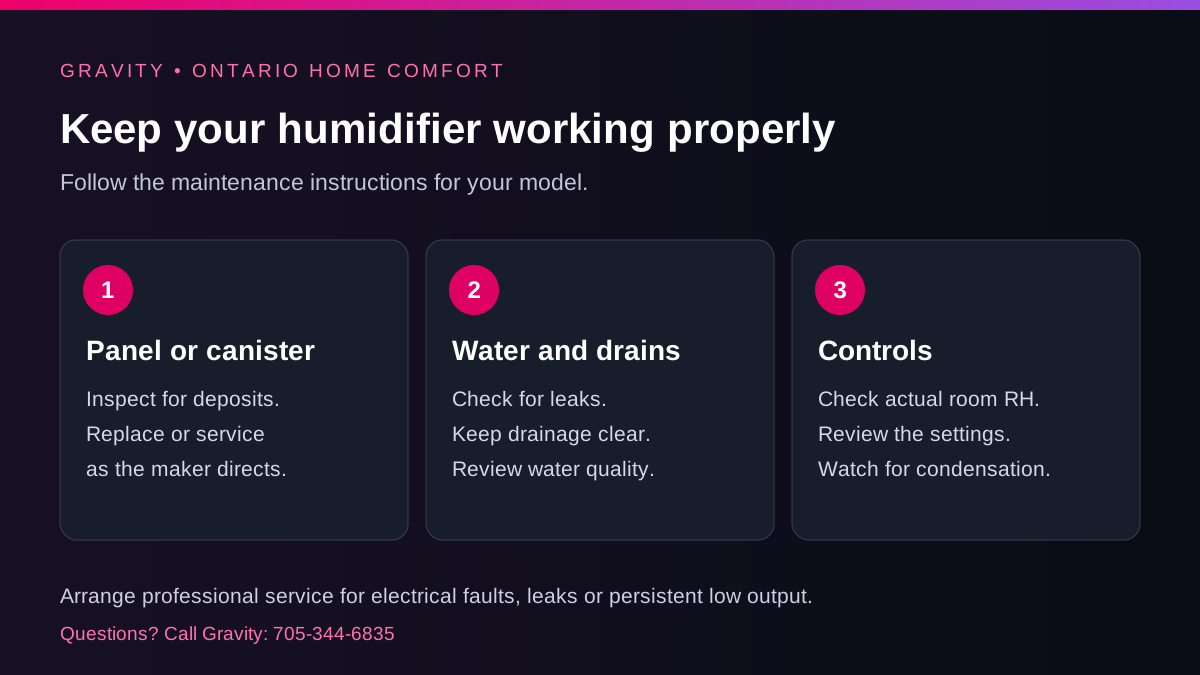
Follow the specific manufacturer’s schedule. Evaporative panels and steam canisters have different service needs, and water conditions can change how often they need attention.
- Inspect or replace the water panel or steam canister as directed
- Clean permitted components and check for mineral buildup
- Check water distribution, valves and drainage
- Inspect for leaks and confirm humidistat operation
- Have control wiring and electrical faults handled by a qualified technician
Pair the check with seasonal HVAC maintenance. Our guide to preparing your furnace for winter covers filters, vents and other basic homeowner checks.
Does Hard Water or Well Water Affect a Humidifier?
Minerals remain as water evaporates and can build up on panels, trays or other components. Iron and sediment can add maintenance concerns at rural properties.
Well water does not rule out humidification. Match equipment and maintenance to the actual water supply. Some steam units have specific conductivity requirements, so softened or treated water is not automatically the right choice for every model.
Gravity’s water treatment services and well-system services can help assess the supply alongside your HVAC needs.
Why Is My Furnace Humidifier Not Working?
Low output may involve a low setting, a closed supply valve, a clogged panel, scale, airflow, a sensor or a control fault. Some units only operate during particular furnace or blower cycles.
Check the user-accessible settings and manufacturer instructions. If the home stays dry despite a call for humidity, have the system diagnosed instead of replacing parts at random.
What If Water Is Leaking From the Humidifier?
Leaks can come from a blocked drain, damaged hose, incorrectly seated panel, valve fault or mineral buildup. Shut off the humidifier’s water supply only if it is safely accessible, and arrange repair.
Do not touch wet electrical components or reach through standing water to operate a switch. Keep clear and call for help if you cannot safely isolate the leak.
Humidifier leaking or not adding moisture?
Call Gravity at 705-344-6835. We answer 24/7 and can help arrange service for the humidifier and connected HVAC system.
How Much Does a Whole-Home Humidifier Cost in Ontario?
The useful number is the installed cost for your home. A basic bypass retrofit and a high-output steam installation can require very different work.
- Equipment type, capacity and controls
- Duct alterations and available mounting space
- Water and drain connections
- Electrical requirements
- Access, commissioning and future maintenance
Ask for a quote that identifies the equipment, installation work and maintenance requirements. Gravity can assess the existing setup and explain options; ask about available financing if you are combining the work with a larger HVAC upgrade.
When Is the Best Time to Install One?
Before heating season is convenient, but a humidifier can often be added during winter or as part of furnace replacement. Confirm persistent low humidity before selecting equipment.
A new furnace is a good opportunity to review controls and ductwork. It does not mean a humidifier is automatically needed. If humidity is already comfortable without condensation, leave that finding in the decision.
Installation in Peterborough, Lindsay and Kawartha Lakes
A draughty Peterborough century home and a newer airtight house can need very different humidity strategies. Around Lindsay and Kawartha Lakes, well water, propane heating, heat pumps and seasonal occupancy add more variables.
Gravity provides whole-home humidifier installation and service as part of its indoor air quality work. An assessment should cover current RH, condensation history, ventilation, airflow, duct space, water quality and the installation requirements.
Humidifier, Air Purifier or Better Ventilation?
| Equipment | Main purpose |
|---|---|
| Humidifier | Adds moisture when indoor air is too dry. |
| Filter or air purifier | Addresses certain airborne particles or contaminants, depending on the technology. |
| HRV or ERV | Supports fresh-air exchange and manages heat or moisture transfer. |
| Dehumidifier | Removes moisture when conditions are too damp. |
Start with the complaint and the measurements. One home may need several improvements; another may need a settings adjustment and maintenance.
Frequently Asked Questions About Whole-Home Humidifiers
What should indoor humidity be in Ontario during winter?
Health Canada generally recommends indoor relative humidity between 30% and 50%, but during colder weather a target closer to 30% may be needed to prevent condensation. The exact setting depends on outdoor temperature and your home's windows and construction.
Is 40% humidity too high in winter?
Not necessarily during mild weather or in a home with high-performance windows. During very cold weather, 40% can cause condensation in some houses. Watch your windows and lower humidity if water or frost forms.
Is 20% humidity too low?
Twenty percent is quite dry. Natural Resources Canada notes that humidity above 20% can reduce some dry-air discomfort and generally recommends 30% to 50%, with lower levels during winter.
How do I know if my house needs a humidifier?
Measure indoor RH with a hygrometer over several days. Persistent low readings and dry-air discomfort may justify a humidifier, but consider outdoor temperature and condensation before increasing humidity.
Will a whole-home humidifier work with my furnace?
Most forced-air systems can support some type of whole-home humidifier, but duct space, airflow, controls, water access, and drainage need to be assessed.
Can a humidifier work with a heat pump?
Yes. Whole-home humidification can be used with heat pumps, but equipment selection matters because heat pumps operate differently from gas furnaces.
Is a whole-home humidifier better than a portable humidifier?
For one room, a portable humidifier may be sufficient. For whole-house humidity control, a properly installed central system is easier to automate and does not require refilling several portable tanks.
Can a furnace humidifier cause mould?
Excess humidity can contribute to mould. A properly adjusted humidifier should maintain an appropriate range rather than making the home excessively humid.
Can a humidifier cause window condensation?
Yes. If indoor humidity is too high for the outdoor temperature and window quality, moisture can condense on the interior glass.
Why do my windows fog after turning on the humidifier?
The humidity setting may be too high. Reduce the setting, especially during colder outdoor temperatures.
Should I turn my humidifier down during a cold snap?
Often, yes. Your home generally tolerates less indoor humidity as exterior temperatures drop.
How often does a furnace humidifier need maintenance?
It depends on the model and water conditions. Water panels, drains, valves, and other components should be checked according to manufacturer instructions. Hard or iron-rich water can increase mineral buildup.
Can well water damage a humidifier?
Minerals, hardness, sediment, and iron can increase maintenance requirements. Appropriate filtration, equipment selection, and more frequent service may help.
Should I run my humidifier in summer?
Whole-home furnace humidifiers are generally intended for dry heating-season conditions. Ontario summers often require moisture removal rather than added humidity.
What humidity level causes mould?
There is no single instant threshold where mould automatically appears, but Health Canada recommends keeping indoor RH between 30% and 50% and addressing persistent excess moisture.
Does a humidifier help with dry skin?
Low humidity can contribute to dry-air discomfort. Raising very low indoor humidity into an appropriate range may improve comfort, but a humidifier is not medical treatment.
Does a humidifier save money on heating?
Do not count on a humidifier for direct energy savings. Its main purpose is humidity and comfort control.
Who installs whole-home humidifiers in Peterborough and Kawartha Lakes?
The Gravity Group installs and services whole-home humidifiers and other indoor air quality equipment across Peterborough, Lindsay, Kawartha Lakes, and surrounding communities. Call 705-344-6835 to book service or request a quote.
House Too Dry This Winter? Talk to Gravity.
Measure your humidity. Watch your windows. Then choose a setup that suits your HVAC system and the house itself.
Get humidity control that fits your home
Call 705-344-6835 or request a quote for whole-home humidifier installation and service in Peterborough, Lindsay and Kawartha Lakes. Always available. Always reliable. Always answers the phone.
Ready for next steps?
Book service, ask about financing, or browse protection plans — we are always available.