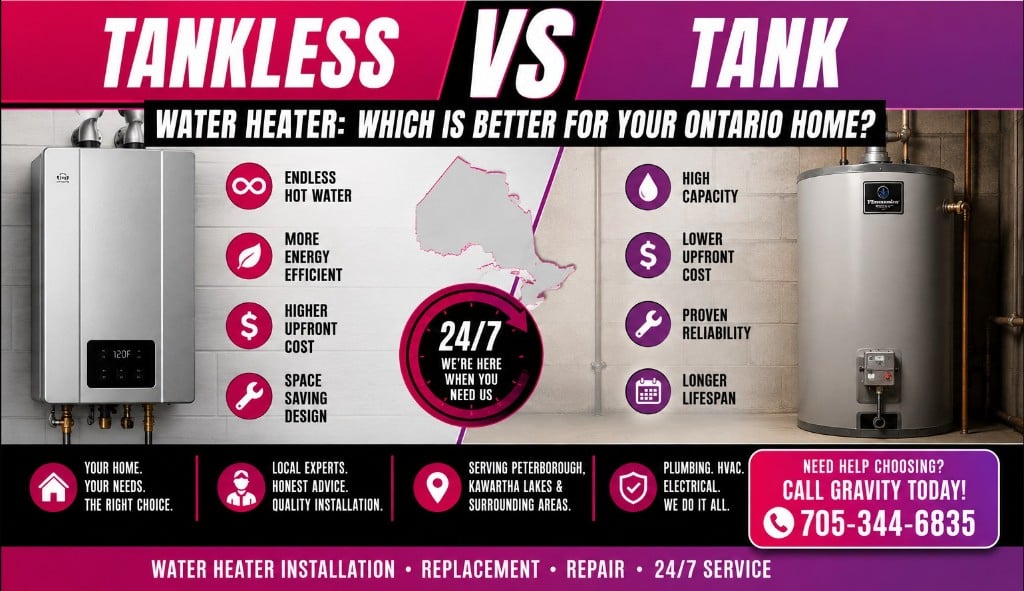
If you are comparing a tankless vs tank water heater, there is no automatic winner.
A tankless water heater can reduce energy use, save floor space and provide a continuous supply of hot water when the system has been sized correctly.
A traditional hot water tank usually costs less to install, works well for many Ontario homes and can handle large short-term hot-water demands without requiring the same type of system conversion.
The right choice depends on your house, fuel source, plumbing, family size, hot-water habits and budget.
For homeowners in Peterborough, Lindsay, Kawartha Lakes and surrounding communities, there is another factor: your existing mechanical setup. Replacing one storage tank with another may be relatively straightforward. Switching from a conventional tank to tankless can involve changes to gas piping, venting, electrical supply, drainage or other mechanical components.
So before you buy based on a product ad or an online calculator, compare the two systems based on how your home actually uses hot water.
Thinking about replacing your water heater?
Call Gravity at 705-344-6835 or request a quote. We install tank and tankless systems across Peterborough, Lindsay and Kawartha Lakes.
Tankless vs Tank Water Heater: The Quick Answer
A traditional tank water heater stores a set amount of heated water and keeps it ready for use. A tankless water heater heats water as it passes through the unit instead of storing a large volume of hot water. That creates a very different experience.
| Feature | Tank Water Heater | Tankless Water Heater |
|---|---|---|
| Stores hot water | Yes | No |
| Heats water on demand | No | Yes |
| Floor space required | More | Less |
| Upfront installation | Generally lower | Generally higher |
| Energy use | Includes standby heat loss | Heats primarily during demand |
| Long showers | Limited by tank capacity/recovery | Continuous within unit flow capacity |
| Multiple simultaneous fixtures | Often handles short heavy demand well | Depends heavily on flow capacity |
| Installation complexity | Usually simpler replacement | Conversion can require upgrades |
| Maintenance | Regular inspection recommended | Regular service can be especially important |
| Best fit | Simple, proven hot-water supply | Efficiency, space savings and long-duration demand |
Natural Resources Canada says storage tank systems remain the most common type of water heater in Canadian homes. It also reports that ENERGY STAR certified tankless systems use about 30% less energy on average than a storage tank type.
That sounds like an easy win for tankless. It is not always that simple. Your actual savings depend on the equipment, fuel source, hot-water use, installation and operating conditions.
What Is a Traditional Tank Water Heater?
A storage tank water heater does exactly what the name suggests. It heats water and stores it inside an insulated tank until someone needs it.
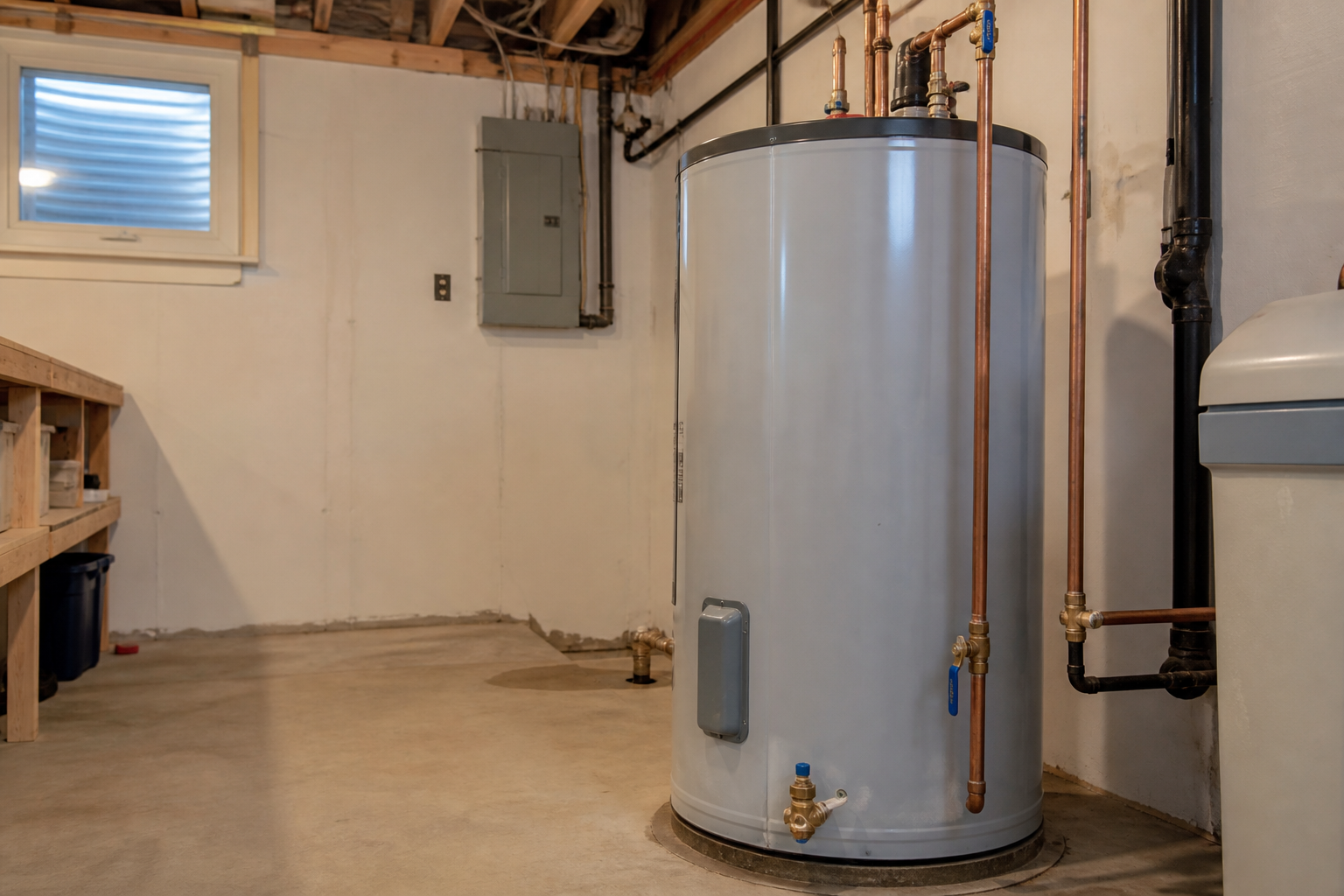
When you take a shower, run a bath, wash dishes, use hot water at a sink or run an appliance connected to hot water, heated water leaves the top of the tank. Cold water enters to replace it. The water heater then heats the incoming water.
Common residential tanks can use natural gas, propane or electricity. Gravity installs and replaces traditional tank systems as well as tankless water heaters across its service area — start on our hot water tank page for service options.
The main advantage of a tank
It is simple. The system keeps a volume of hot water ready for use. For many houses, replacing an existing tank with a similar new unit can also require fewer mechanical changes than converting the house to tankless.
The main disadvantage
The water heater needs to keep stored water hot even when nobody is using it. That creates standby heat loss. Modern tanks use insulation and other efficiency improvements to reduce those losses. Natural Resources Canada says an ENERGY STAR certified gas-fired storage tank water heater uses about 14% less energy on average than a standard model.
What Is a Tankless Water Heater?
A tankless water heater does not keep a large tank full of hot water. Instead, the unit detects water flow when you open a hot-water fixture. Water passes through the system. The burner or heating element raises the water temperature as it moves through the unit. When you stop using hot water, the unit stops heating it.
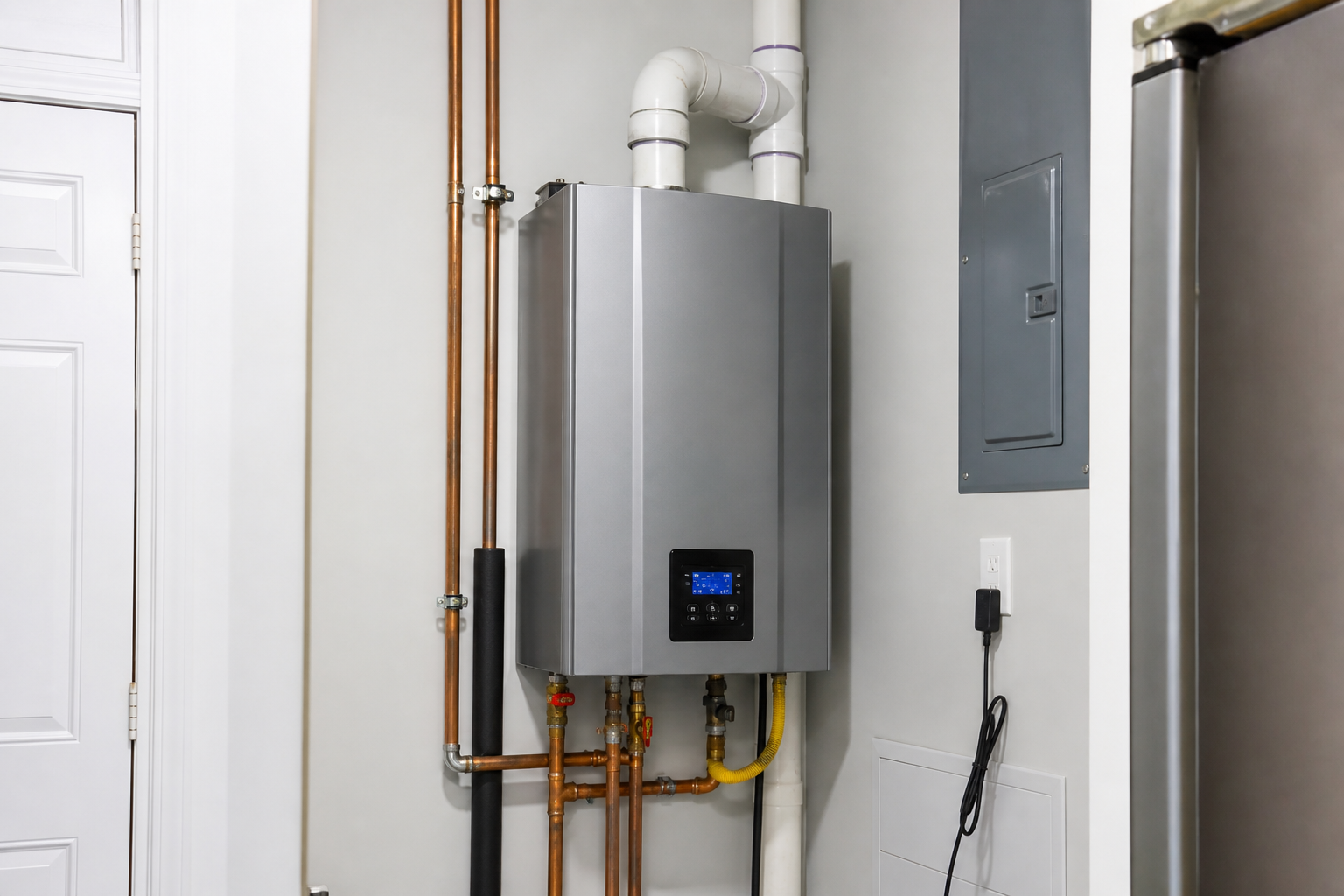
This is why you will also hear tankless systems called on-demand water heaters, instantaneous water heaters or on-demand hot water systems.
The biggest benefit is simple: you are not continuously heating a full storage tank. Natural Resources Canada says ENERGY STAR certified tankless water heaters use about 30% less energy on average than storage tank types.
Tankless units also take up much less physical space. For basements and mechanical rooms where every square metre matters, that can be attractive.
Want tank or tankless for your house?
Gravity can assess your fuel source, plumbing and peak hot-water demand, then quote the right system — not a one-size-fits-all upsell.
Tankless Does Not Mean Unlimited Hot Water for Everything at Once
This is one of the biggest misconceptions about tankless water heaters. You often hear that tankless gives you unlimited hot water. That is only partially true.
A properly sized tankless system can continue heating water for a long shower because it is not waiting for a storage tank to refill. But every tankless unit has a maximum flow capacity. The system can only heat a certain amount of water at one time.
Natural Resources Canada notes that tankless systems can have trouble meeting very large simultaneous hot-water demands. Multiple showers at the same time can exceed the capacity of an undersized system.
Imagine this: shower #1 is running, shower #2 starts, the dishwasher is operating, and someone turns on a hot-water tap. A properly sized system may handle the load. An undersized one may not.
This is why sizing matters so much with tankless. Do not choose one based only on the number of bedrooms in your house. You need to consider actual simultaneous hot-water demand.
Tankless vs Tank Water Heater: Which Uses Less Energy?
In general, tankless systems have an efficiency advantage because they do not keep a large reservoir of water heated all day.
Natural Resources Canada estimates water heating accounts for about 19.3% of total energy use in the average Canadian household, making it the second-largest household energy use category after space heating. That makes water-heater efficiency worth paying attention to.
But do not compare systems using marketing language alone. Look at the actual efficiency rating. For gas and propane storage water heaters, EnerGuide uses Uniform Energy Factor, or UEF, to compare energy performance between similar-capacity products. A higher UEF indicates better energy efficiency within the appropriate product category.
Your operating cost will also depend on fuel price, household size, shower habits, water temperature setting, appliance use, equipment efficiency, maintenance, incoming water temperature and how much hot water you actually use.
Does a Tankless Water Heater Save Money?
It can. But this is where homeowners need to separate energy savings from total project cost.
A tankless unit can consume less energy. The conversion may also cost more upfront. If your house currently has a standard storage tank, switching to tankless may require work involving gas supply, venting, condensate drainage, electrical connections, water piping, equipment mounting and removal of the existing tank.
That means "How much does a tankless water heater cost?" cannot be answered accurately from the unit price alone. The real number is the installed cost for your house.
Gravity offers on-site assessments for water-heater projects and Financeit options for homeowners replacing or upgrading their hot-water systems.
Want a real tankless quote?
Skip the generic online estimate. Call Gravity at 705-344-6835 for an on-site assessment based on your home.
Is Tankless Always Cheaper to Operate?
No. Tankless equipment can reduce energy consumption, but actual operating cost still depends on the system and household.
If you use huge amounts of hot water every day, you still need energy to heat that water. Tankless eliminates much of the energy associated with keeping stored water hot. It does not eliminate the energy needed to raise incoming cold water to your chosen hot-water temperature.
A tankless unit can improve how efficiently you produce hot water. It does not make hot water free.
Which Gives You More Hot Water?
This depends on how you define "more."
A tank has a fixed reserve
A storage tank gives you a set amount of hot water. Once you use most of that heated water, the system needs time to recover. That can create the classic problem: three people shower and the fourth person gets cold water.
Tankless keeps heating
A properly sized tankless unit can keep producing heated water as long as the demand stays within its capacity. That makes it attractive for long showers, large tubs, families using hot water throughout the day, and homes that regularly drain a conventional tank.
But simultaneous demand changes the equation. If three showers, a dishwasher and another fixture all call for hot water at once, the tankless unit needs enough flow capacity to keep up. That is why professional sizing should focus on your peak demand, not just average daily use.
Tankless vs Tank Water Heater for a Large Family
Large families can benefit from either system. The better choice depends on usage patterns.
Tankless may work well if people shower one after another, you frequently run out of stored hot water, you want longer hot-water availability, and the system has enough capacity for your peak demand.
A tank may work well if your family creates short bursts of heavy hot-water use, several fixtures regularly operate at the same time, you already have an appropriately sized tank setup, or you want a simpler replacement.
Do not assume "large family equals tankless." A properly sized tankless system can be excellent for a large household. An undersized one can be frustrating.
Which Takes Up Less Space?
Tankless wins easily. Traditional water heaters need room for the storage tank. Tankless units typically mount on a wall.
Removing a large tank can free up usable space in utility rooms, basements, mechanical rooms, smaller homes, cottages and finished basement areas. Space alone may not justify the conversion, but it can be a strong secondary benefit.
Gas vs Electric Water Heaters
The tank vs tankless decision is only one part of the equation. You also need to consider the energy source.
- Gas storage water heaters heat a stored volume of water using natural gas or propane
- Electric storage tanks use electric heating elements inside the tank
- Gas tankless water heaters use a gas burner to rapidly heat water as it flows through the unit
- Electric tankless water heaters use electric resistance heating and may need substantial electrical capacity
Whole-home electric tankless systems can require significant electrical service capacity, so the home's panel should be considered before selecting one — especially if you are already planning a 200-amp electrical service upgrade or other residential electrician work.
Do not pick the technology in isolation. Look at what infrastructure your house already has.
Is Tankless Better for Peterborough and Kawartha Lakes Homes?
It can be. But local housing varies significantly — older Peterborough homes, newer subdivisions, rural houses, waterfront homes, seasonal cottages, renovated farmhouses, propane properties, natural-gas homes, electrically heated properties, houses with wells and large multigenerational homes.
A solution that makes sense in one house may make little sense 20 minutes away. That is one reason generic "best water heater" lists are limited. Your existing utilities and mechanical layout matter.
What About Hard Water and Mineral Buildup?
Water quality matters for any water heater. Minerals can accumulate on components that heat or store water.
Tankless equipment uses compact heat exchangers with water passing directly through them. That makes regular service and manufacturer-recommended maintenance important.
Natural Resources Canada recommends having tankless water heaters serviced every year or two by a qualified professional while also directing homeowners to follow the specific maintenance schedule in their owner's manual.
If your home has mineral-heavy water, ask about water softeners and treatment options as part of the conversation — hard water can shorten equipment life for both tank and tankless systems.
Do not buy tankless and assume it never needs attention. It is efficient equipment. It still needs maintenance.
Does a Hot Water Tank Need Maintenance Too?
Yes. Storage tanks also benefit from regular inspection and service. Depending on the equipment, maintenance can involve checking temperature settings, safety controls, venting, burner operation, anode condition, sediment accumulation, visible corrosion, water connections and signs of leakage.
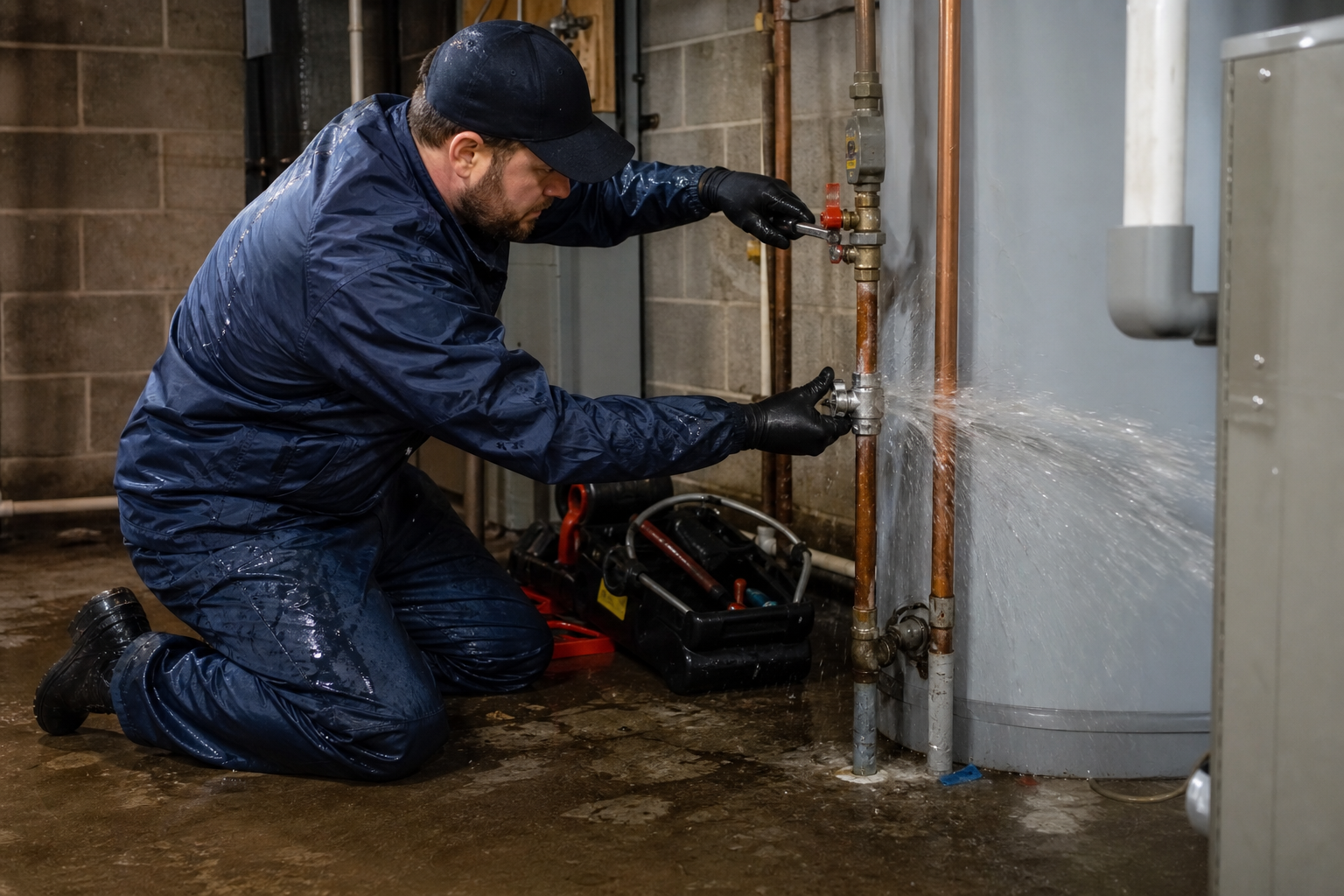
A neglected tank can eventually create expensive problems. Gravity already has a separate emergency guide covering burst hot water heater or burst pipe situations. This article serves a different customer: someone deciding what to install before their current system becomes an emergency.
When Should You Replace Your Water Heater?
Do not wait for water to start pouring across the basement floor. Start planning if your water heater shows signs such as:
- Water around the base or visible corrosion
- Rust-coloured water or inconsistent hot water
- Reduced hot-water capacity or unusual noises
- Repeated repairs or increasing difficulty meeting household demand
Age matters too, but condition matters more than picking an arbitrary birthday for the equipment. A professional inspection can tell you if repair still makes sense or if replacement is the smarter use of money.
Should You Repair or Replace a Water Heater?
Ask three questions.
1. What actually failed?
A small serviceable component does not automatically mean you need a new system. A leaking tank is a very different problem.
2. What condition is the rest of the unit in?
Spending money repairing one part of an older, deteriorating system may not make sense.
3. Are you happy with the current setup?
A breakdown can be an opportunity to fix a system that never really suited the house. Maybe you constantly run out of hot water. Maybe the tank takes up too much space. Maybe your family has grown. Or maybe your existing tank has worked perfectly and you simply want a modern replacement.
When Does Switching to Tankless Make the Most Sense?
Tankless deserves serious consideration when several of these apply:
- You frequently run out of hot water or want long-duration availability
- You want to reduce standby energy losses or free mechanical-room space
- You plan to stay in the home for years and existing equipment needs replacement anyway
- Your gas, venting and plumbing setup can support the conversion
- You are prepared to maintain the equipment properly
It can also make sense during a larger renovation because mechanical work is already taking place.
When Is a Traditional Hot Water Tank the Better Choice?
Tankless is not automatically the smart upgrade. A new tank may be the better decision when your existing tank setup works well, you want a lower upfront installation cost, you need a straightforward replacement, your current fuel and venting arrangement supports a tank easily, you have no problem with your current hot-water capacity, or the added cost of converting to tankless does not make sense for your plans.
There is nothing wrong with choosing a tank. Modern high-efficiency storage systems remain a practical choice for many Canadian homes. Natural Resources Canada still lists ENERGY STAR certified gas storage models as an efficiency-focused option for homeowners.
Tankless vs Tank Water Heater for a Cottage
Cottages create another set of questions. Think about seasonal use, number of people visiting, propane availability, electrical capacity, water quality, winterization, mechanical-room space and long periods when the property sits unused.
Tankless can be attractive because the system does not keep a full tank heated while you are actively using hot water. A traditional tank may still be the simpler setup at some properties. For Kawartha Lakes cottages — including properties planning cottage electrical upgrades — do not select a system without considering how the property actually operates throughout the year.
Can You Replace a Tank With Tankless?
Yes, many homes can convert. But do not assume the job is simply remove tank, hang tankless unit, done.
The installer needs to examine gas line capacity, gas meter capacity, vent route, combustion requirements, condensate drainage, electrical outlet or circuit needs, water piping, mounting location, service access and required flow rate.
The conversion cost can vary significantly between two houses. This is why an on-site quote matters.
Ready to compare tank vs tankless on-site?
Call Gravity at 705-344-6835. We assess the house first — then recommend the system that actually fits.
How Do You Size a Tankless Water Heater?
Tankless sizing revolves around two major factors: flow rate (how many litres of hot water the house needs at one time) and temperature rise (how much the incoming water temperature needs to increase before reaching the desired outlet temperature).
A home with greater simultaneous demand needs more capacity. That means the plumber needs to think about fixtures that may operate at once — shower, second shower, kitchen faucet, dishwasher and laundry.
Natural Resources Canada specifically recommends having an experienced plumber estimate the household's hot-water demand before choosing a tankless system. This is one area where guessing can become expensive.
How Do You Size a Traditional Hot Water Tank?
Tank sizing also depends on demand. A larger household typically needs more stored hot water or better recovery performance. But simply buying the biggest tank available is not the goal.
You want a system matched to household size, peak use, fuel type, available space and recovery needs. EnerGuide labels for gas and propane storage water heaters include capacity information and efficiency measurements that help homeowners compare similar products.
Which Water Heater Is Better for Resale?
Do not choose your water heater around a theoretical future buyer. Choose a system that works properly for the home.
A professionally installed, properly sized and well-maintained system is far more useful than installing tankless simply because it sounds premium. Some buyers may appreciate tankless. Others may care more about reliability, equipment age, operating cost, hot-water performance and maintenance history.
What About Financing a New Water Heater?
A water-heater failure does not always happen when you planned to spend money on the mechanical room. Gravity currently offers financing options for water-heater replacements and upgrades through Financeit.
That can make it easier to compare the right system based on long-term use rather than selecting equipment solely around the immediate cash cost. Ask about available financing when requesting your quote.
Tankless vs Tank Water Heater: Which One Should You Buy?
Here is the simplest way to make the decision.
Choose a tankless water heater if:
- Energy efficiency and reduced standby heat loss are high priorities
- You want to free up floor space or regularly run out of hot water
- You want long-duration hot water and your home can support the installation
- You are comfortable with the higher initial investment
Choose a traditional tank if:
- You want a simpler replacement with lower upfront cost
- Your current setup already performs well
- Your household needs are predictable
- You want to avoid a more involved conversion
- A modern high-efficiency tank meets your needs
Still unsure? That is normal. A good installer should not force every homeowner toward the same technology. The recommendation should come after looking at the house.
Water Heater Installation in Peterborough, Lindsay & Kawartha Lakes
Gravity installs and replaces water heaters across Peterborough, Lindsay, Kawartha Lakes and surrounding areas. That includes traditional hot-water tanks and tankless systems, with on-site assessments and financing options.
If your current water heater is leaking, running out of hot water, making strange noises, producing inconsistent temperatures, showing signs of corrosion, requiring repeated repairs or no longer meeting your family's needs — you do not need to guess what comes next.
Have the system looked at. Compare the actual options for your home. Then make the call based on installation cost, operating needs and how long you plan to use the system.
Need a new water heater?
Call Gravity at 705-344-6835. Water heater installation across Peterborough, Lindsay, Kawartha Lakes and surrounding communities.
Frequently Asked Questions: Tankless vs Tank Water Heaters
Is a tankless water heater better than a tank?
Tankless water heaters can offer lower energy use, reduced standby losses, space savings and continuous hot water within the unit's rated flow capacity. Traditional tanks can cost less to install and remain a practical option for many households. The better system depends on your home and hot-water demand.
Do tankless water heaters really give unlimited hot water?
They can provide continuous hot water for long periods, but they do not provide unlimited flow. Every tankless unit has a maximum capacity. Heavy simultaneous use can exceed that capacity.
What happens if a tankless water heater is too small?
The unit may struggle when multiple fixtures call for hot water at the same time. Proper sizing needs to account for peak simultaneous demand.
Is tankless cheaper to run?
Tankless systems can use less energy because they avoid continuously maintaining a stored volume of hot water. Natural Resources Canada reports that ENERGY STAR certified tankless systems use about 30% less energy on average than storage tank types. Actual household savings vary.
Is a tankless water heater more expensive to install?
Tankless projects often have a higher initial cost, especially when converting from a storage tank. Gas piping, venting, drainage, electrical or plumbing work may need changes.
Can I replace my existing hot water tank with tankless?
Many homes can convert to tankless. An installer needs to check gas or electrical capacity, venting, plumbing, drainage and the home's hot-water demand first.
Does a tankless water heater need maintenance?
Yes. Natural Resources Canada recommends professional service every year or two while also advising homeowners to follow their specific manufacturer's maintenance instructions.
Does a regular hot water tank need maintenance?
Yes. Storage systems should be inspected for leaks, corrosion, sediment, venting problems and other equipment-specific issues.
Which is better for a family of five?
Either system can work. A tankless system needs enough flow capacity for simultaneous use. A storage system needs adequate tank volume and recovery performance. Household habits matter as much as family size.
Which water heater takes up less space?
Tankless units take up substantially less floor space because they do not use a large storage tank.
Can tankless run two showers at once?
A properly sized unit may handle multiple fixtures simultaneously, but available flow varies by equipment and incoming water temperature. This is why sizing calculations matter.
Is tankless good for a cottage?
It can be. Cottage owners need to consider seasonal use, propane or electrical supply, water quality, winterization and peak occupancy before selecting equipment.
Should I switch to tankless when my old tank fails?
Not automatically. A failed tank is a good time to compare the options. If your current setup met your needs and you want a straightforward replacement, another storage tank may make sense. If you want better efficiency, space savings or longer hot-water availability, tankless deserves consideration.
How do I compare water-heater efficiency?
Look at the appropriate EnerGuide and ENERGY STAR information for the equipment category. For gas and propane storage systems, UEF provides an efficiency measurement for comparison between similar-capacity models.
Who installs tankless water heaters in Peterborough?
Gravity installs tankless and traditional water-heating systems in Peterborough, Lindsay, Kawartha Lakes and surrounding communities. Call 705-344-6835 to discuss your home or request a quote.
Stop Guessing. Get the Right Water Heater for Your House.
The tankless vs tank water heater debate does not need to be complicated.
Tankless gives you several clear benefits: less standby energy use, a smaller equipment footprint and continuous hot water within rated capacity. Traditional tanks also have strong advantages: simpler replacements, lower initial investment in many installations, proven performance and strong short-term hot-water availability.
The wrong move is choosing one based on a headline. The right system depends on your house. Gravity can look at your existing equipment, hot-water demand, fuel source and installation requirements, then give you options that make sense.
Hot water tank done? Thinking about tankless?
Call Gravity at 705-344-6835. Always available. Always reliable. Always answers the phone across Peterborough, Lindsay, Kawartha Lakes and surrounding Ontario communities.
Ready for next steps?
Book service, ask about financing, or browse protection plans — we are always available.